27 Antique Wall Shelf Displays That Transform Your Walls Into Art
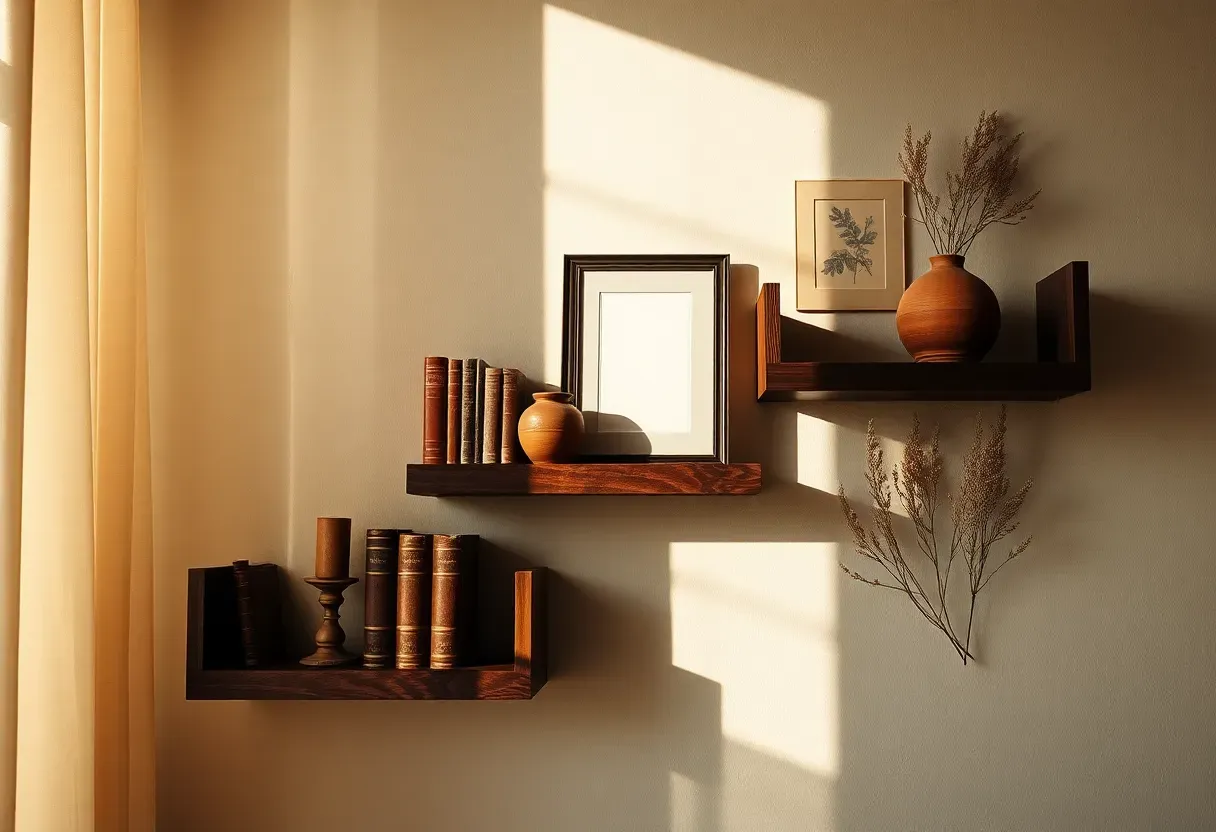
Picture a wall that doesn't just hold things — it tells a story. Antique wall shelf displays occupy a rare design space where function and memory intersect. A shelf is already an invitation: it says, here is something worth looking at. Fill it with objects that carry age, patina, and history, and suddenly a bare wall becomes the most compelling surface in the room.
The appeal goes beyond aesthetics. Vintage objects bring irreproducible texture — the grain of a leather binding, the oxidized edge of a brass candleholder, the translucency of hand-blown glass. These qualities aren't available in a mass-production showroom. They accumulate through time, and that is exactly what makes them worth displaying.
Below you'll find 27 distinct antique wall shelf display ideas drawing on eras and styles from Victorian studies to Eastern European folk traditions. Each one is a starting point, not a prescription — the best curated shelf is always part someone else's blueprint and part your own collected life.
Table of Contents
- Victorian Library Corner
- Farmhouse Apothecary Shelf
- French Country Classics
- Dark Academia Gallery Wall
- Botanist's Cabinet Display
- Antique Clock Collection
- Heirloom China Vignette
- Candlelit Mantel Shelf
- Cottage Pressed Flower Wall
- Industrial Vintage Blend
- Shabby Chic Pastel Arrangement
- Antique Map and Globe Shelf
- Vintage Travel Memorabilia
- Weathered Driftwood Shelf
- Art Nouveau Object Display
- Scandinavian Folk Art Shelf
- Antique Silver Collection
- Rustic Medicinal Herb Shelf
- Vintage Music Corner
- Grandmillennial Book Stack
- Colonial-Era Portrait Shelf
- Antique Lace and Textile Display
- Forgotten Keys and Locksmith Vignette
- Eastern European Folk Ceramics
- Sepia Photography Gallery
- Vintage Science Instruments
- Eclectic Mixed-Era Curio Wall
1. Victorian Library Corner
The Setting
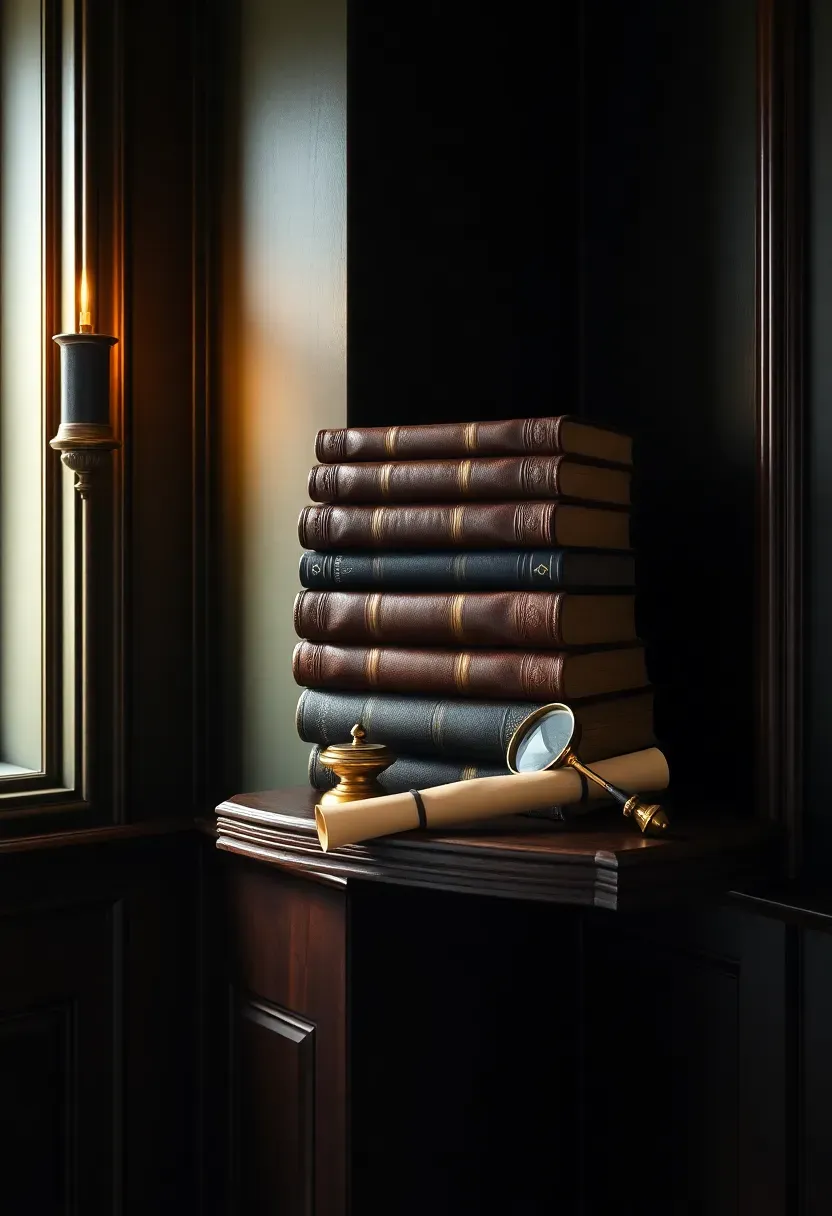
Dark green walls and rich mahogany shelving: the Victorian study aesthetic is as powerful today as it was in its time. A single floating shelf in dark wood becomes a micro-library when stacked with leather-bound books, and every accessory earns its place through usefulness or symbolism.
Building the Vignette
Mount a dark mahogany shelf at eye level on a deep-toned wall. Stack three or four leather-bound books horizontally, then stand one vertically at the end as a bookend. Place a brass inkwell at the front edge and a magnifying glass with a horn handle across the book stack. Roll a piece of cream parchment and tie it with a thin strip of leather cord — it suggests a letter waiting to be read.
Tips for Authenticity
- Source leather-bound books from estate sales rather than decorator props; a cracked spine and foxed pages make the display believable
- Brass objects polish unevenly over time — resist the temptation to shine everything uniformly
- If your walls are light-toned, paint a single shelf-width panel in deep forest green to simulate the Victorian interior behind the display
We picked a few things that go well with this idea: Antique Brass Victorian Wall Shelf Brackets (★4.7), Baroque Style Antique Brass Shelf Brackets 4-Pack (★4.7) and Ornate Victorian Antique Brass Shelf Brackets Small (★4.7). As an Amazon Associate we earn from qualifying purchases.
2. Farmhouse Apothecary Shelf
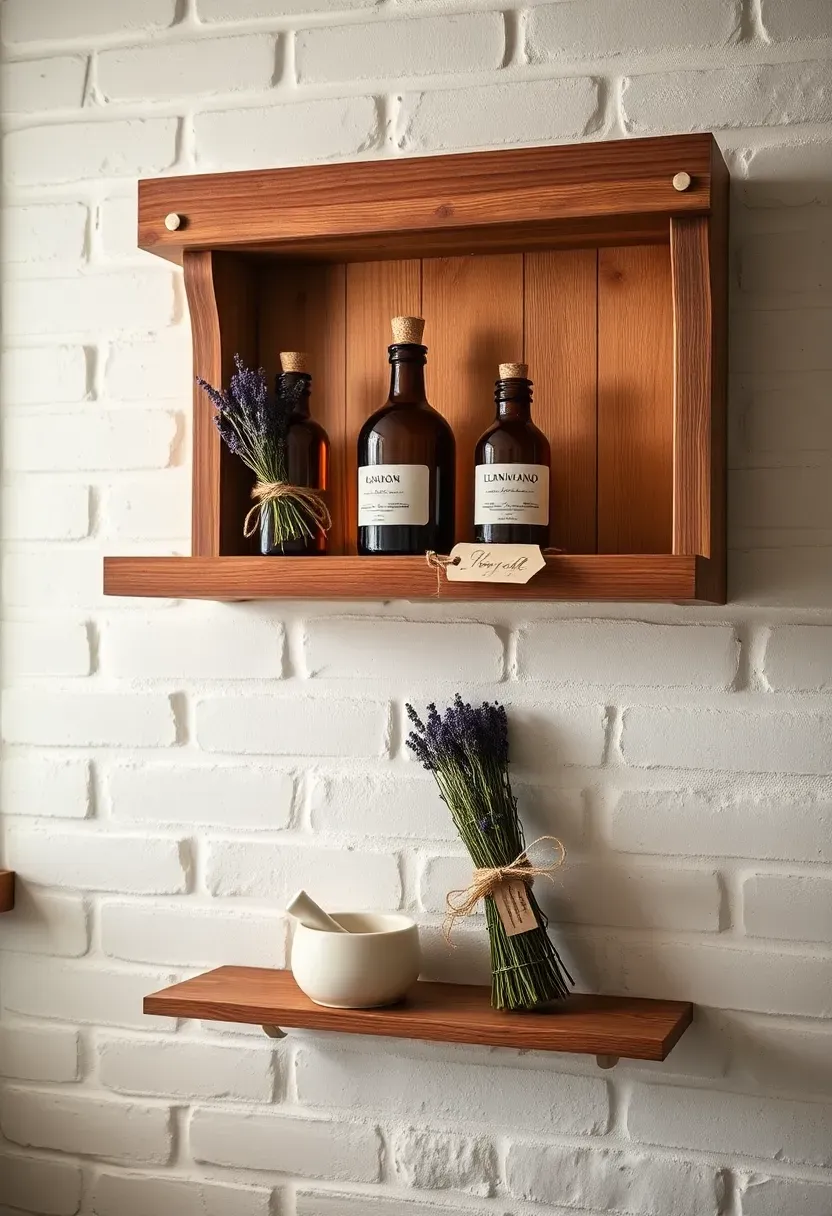
For centuries before commercial pharmacies, every farmhouse kitchen held a shelf of remedies: bottled tinctures, bundles of dried herbs, hand-labeled crocks of salve. Reclaiming this aesthetic produces one of the warmest and most readable antique wall shelf displays possible.
A single reclaimed pine plank on a whitewashed wall is the foundation. Arrange three or four amber apothecary bottles with cork stoppers in graduated sizes. Tuck a bundle of dried lavender tied with natural twine beside them, and set a ceramic mortar and pestle at the end. The functional quality of each object — nothing is purely decorative — is what gives this shelf its credibility.
What to Avoid
Don't use modern pharmacy bottles repainted or relabeled. The glass profile gives them away. Genuine vintage apothecary glass, or quality reproductions with thick molded bases, read completely differently under light.
Don't overcrowd. Five objects maximum. The white space between items matters as much as the items themselves.
We picked a few things that go well with this idea: French Country Vintage Floating Wood Wall Shelves (★4.6), Ornate Antique Gold Owl Manor Floating Shelf (★4.8) and 3-Tier Vintage Wooden Display Shelf Shadow Box (★4.4). As an Amazon Associate we earn from qualifying purchases.
3. French Country Classics
Origins
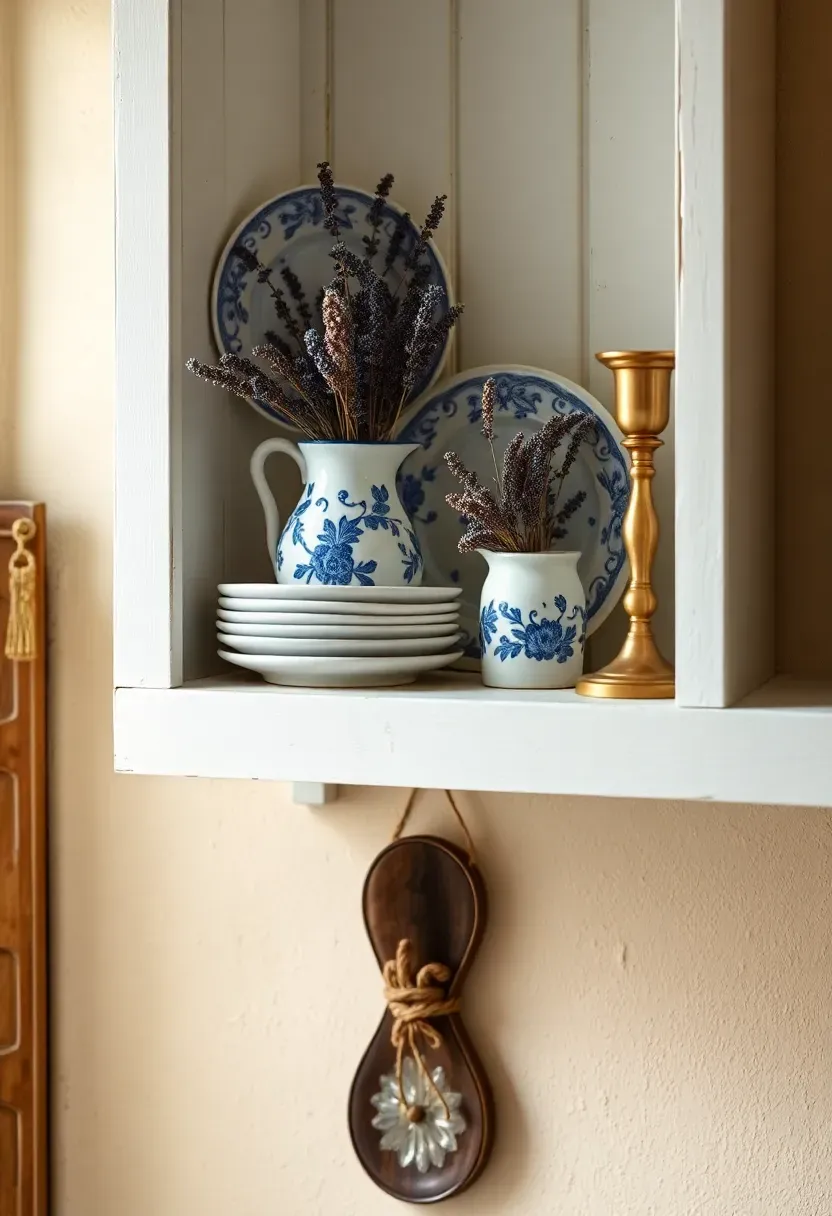
Provençal kitchens and farmhouse dining rooms developed a shelf aesthetic rooted in daily life: the china that came out for Sunday meals, the lavender grown in the garden, the brass candlestick passed down through the household. These weren't decorative choices — they were simply the beautiful objects of everyday French rural life.
Modern Interpretation
Today, a painted distressed white shelf holding two or three pieces of faience in classic blue-and-white captures this spirit without requiring an actual Provençal farmhouse. The key ingredients are: hand-painted ceramics (even small chips authenticate the look), at least one dried or fresh lavender element, and something in aged brass. Prop faience plates upright at the back to introduce vertical interest without additional height.
How to Apply at Home
- Distress a plain white-painted shelf using fine sandpaper on corners and bracket edges — not uniformly, but in spots that would naturally receive wear
- Replace generic white candles with beeswax or honey-toned tapers for a warmer palette
- A small bunch of real dried lavender costs very little and carries genuine fragrance that synthetic props never achieve
- Mix plate sizes rather than matching them; perfectly matched sets look purchased rather than collected
We picked a few things that go well with this idea: Clear Glass Apothecary Cork Bottles Set of 3 (★4.7), MyGift Fleur De Lis Glass Apothecary Bottles Set (★4.7) and Amber Vintage Medicine Apothecary Jars Set of 6 (★4.9). As an Amazon Associate we earn from qualifying purchases.
4. Dark Academia Gallery Wall
Why It Works
The dark academia aesthetic — moody, literary, obsessed with learning and death in equal measure — has found a devoted following because it names a longing that many people already feel: for rooms that feel intellectually serious, where objects suggest a life of the mind rather than a lifestyle brand.
The Shelf Build
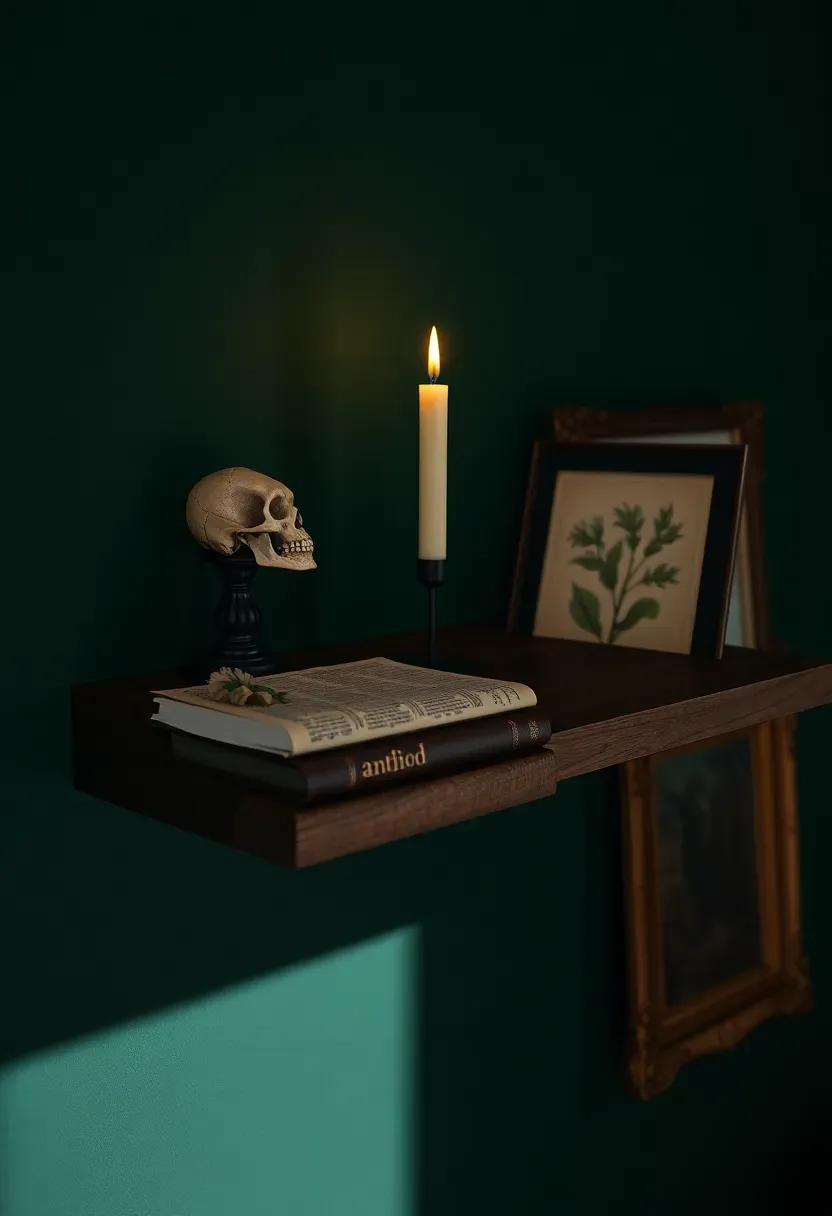
A deep walnut floating shelf against a forest-green or near-black painted wall is the physical foundation. Place an open anthology face-down (or closed with a cracked spine showing) at one end. A taper candle in a matte black iron holder at the other. Between them, a skull paperweight — resin or real plaster — and a framed antique botanical print leaning against the wall. The frame should be slightly too large for the print, with wide mat board showing: it implies the print was found rather than commissioned.
The Essential Details
Keep the lighting low and directional. A wall sconce above the shelf, or a small desk lamp aimed upward from a lower surface, creates shadows that the aesthetic depends on. Overhead ambient lighting destroys the mood entirely.
Recommended
Items for this idea
5. Botanist's Cabinet Display
The Core Idea
Nineteenth-century botanists documented plants obsessively — pressing, labeling, storing specimens in glass jars and leather-bound herbaria. Translating this practice into a wall shelf display requires only a few key objects to trigger the full associative power of the reference.
The Arrangement
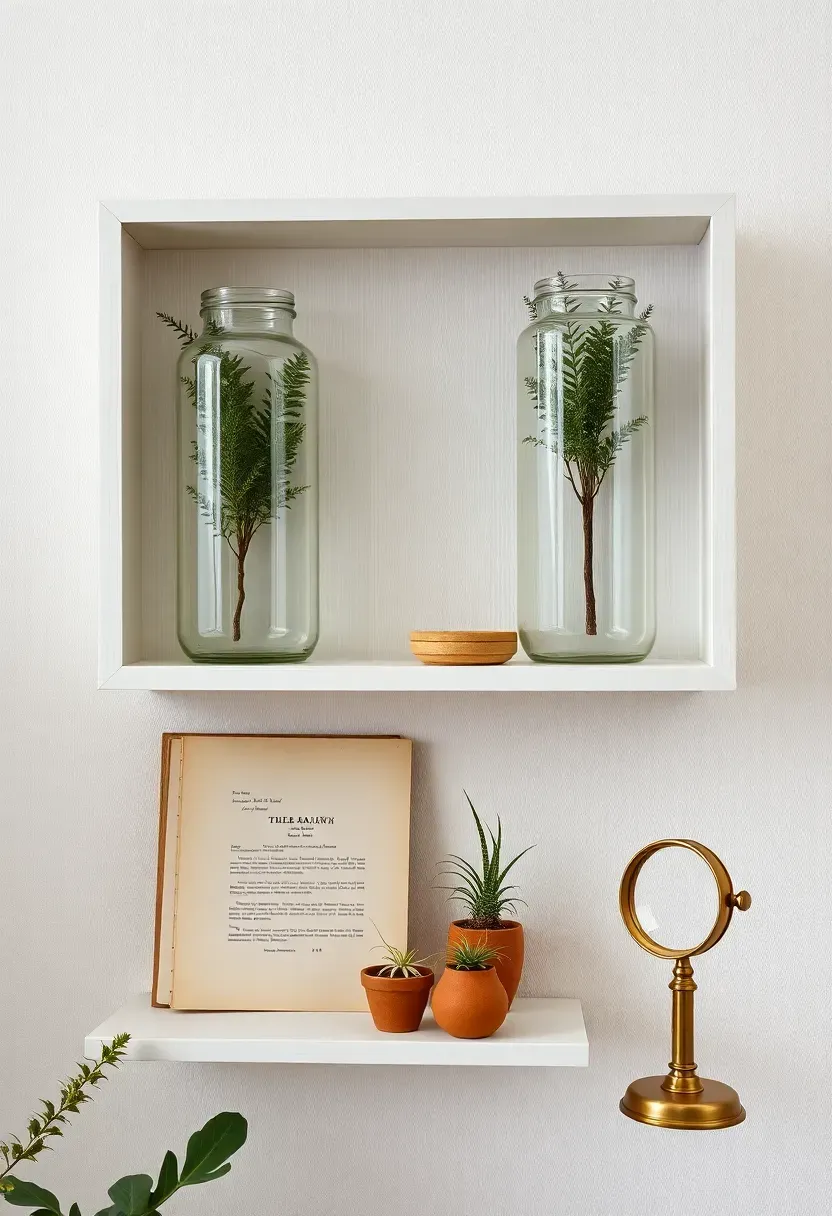
Two slim white-painted shelves work better than one here — the botanist's collection spans multiple levels. Upper shelf: glass specimen jars holding preserved ferns or dried seed pods, plus a pressed flower book open to a particularly beautiful page. Lower shelf: three small terracotta pots with air plants, and a brass magnifying loupe on a small stand. The mix of living plant material and preserved specimens creates the productive tension that makes a botanist's shelf come alive.
Pros and Cons
Pros: Air plants require minimal care, glass specimen jars are widely available and inexpensive, the display evolves naturally as plants change
Cons: The "scientific" quality demands restraint — adding too many objects tips it from scholarly to cluttered; specimen jars need regular dusting to maintain clarity
6. Antique Clock Collection
There's something inherently poetic about displaying clocks that no longer keep accurate time. Freed from their function, they become pure form — an accumulation of human ingenuity across different eras, all speaking the same language through gears, hands, and glass.
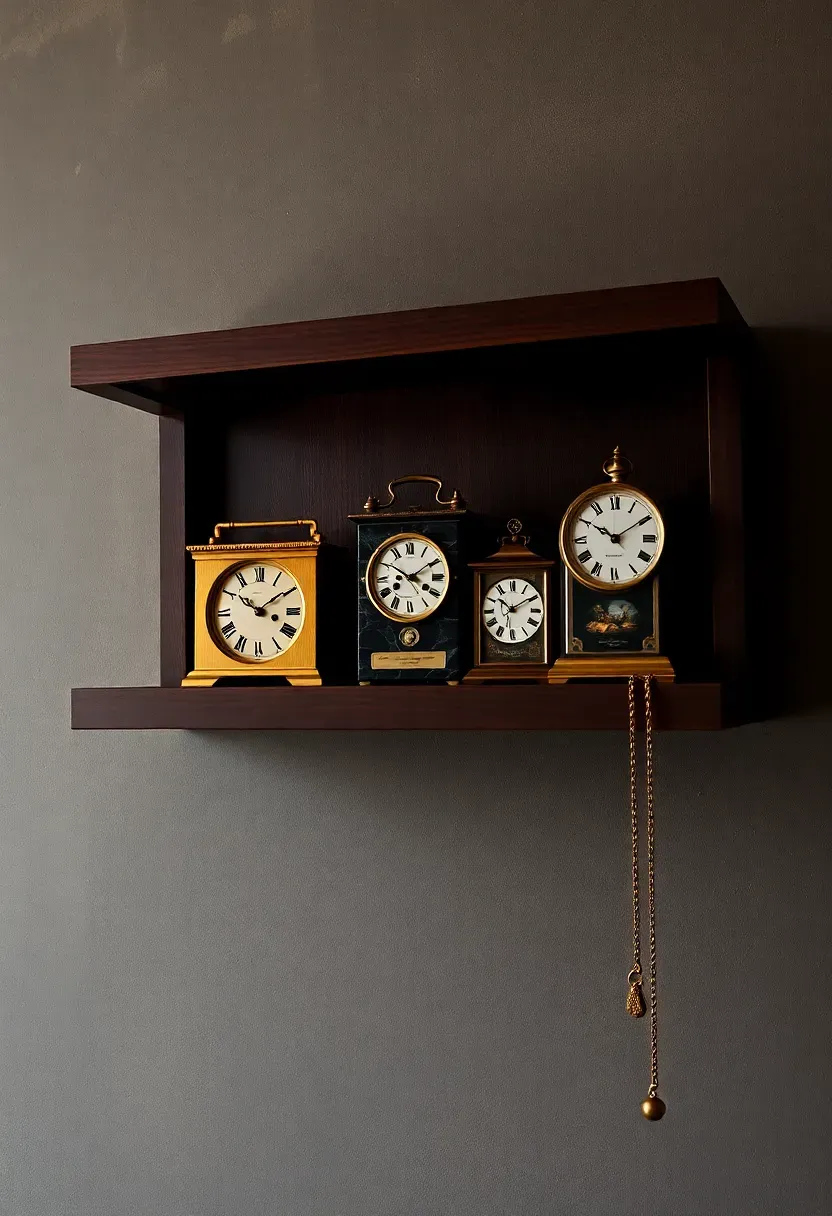
Three clocks of different mechanical eras and visual languages transform a wide dark oak shelf into a meditation on time itself. The hierarchy is simple: tallest piece toward the back or center, smaller pieces flanking. A coiled pocket watch chain draped between two of them adds the right note of intimate scale — the kind of detail a careful collector would add.
Sourcing and Placement
Brass carriage clock: the most findable and typically most affordable of Victorian portable clocks. Scratches on the brass case add rather than subtract from value.
Marble mantel clock: heavier, requiring a sturdier shelf. The visual weight anchors the display.
Painted enamel alarm clock: introduces color and a slightly later era, preventing the collection from reading as uniform.
Vary the spacing — equal spacing between all three looks retail; asymmetric spacing looks collected.
Recommended
Items for this idea
7. Heirloom China Vignette
Step 1: Establish the Palette
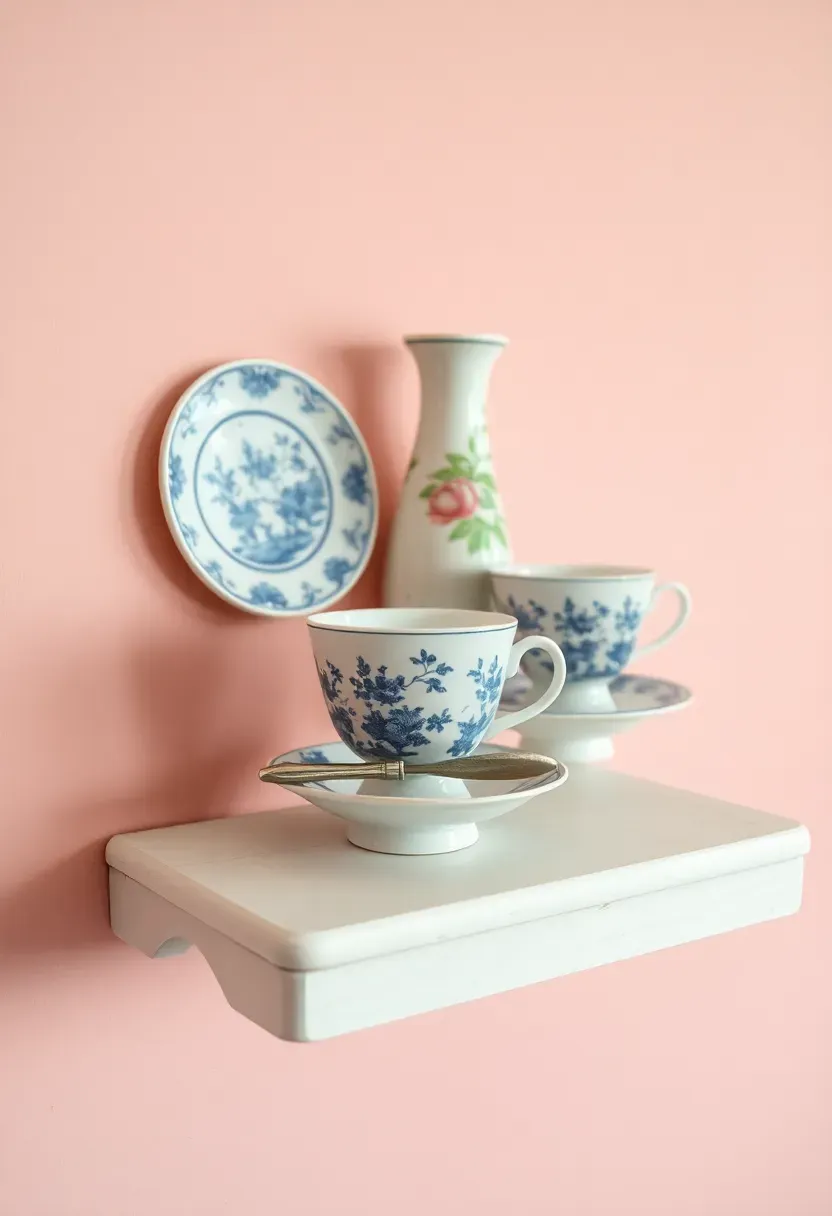
Transferware china, with its characteristic blue-on-white printed pattern, sets the tone. Choose a pattern with botanical or pastoral imagery rather than geometric abstraction — the former connects to the natural world that antique collectors always gravitated toward.
Step 2: Compose the Shelf
Place a hand-painted floral porcelain vase at the back of a white-painted shelf. Set two teacups on their saucers to the left, slightly offset from each other. Rest a small pair of silver-plated sugar tongs across the front saucer edge — an object mid-use, suggesting someone stepped away from their afternoon tea.
Step 3: Let Imperfection Show
Hairline crazing in the glaze is not damage — it is documentation. The spiderweb of tiny cracks that develops in old glazes over decades is exactly what distinguishes genuine china from reproduction. Don't attempt to disguise it. Display pieces face-on so the crazing catches the light.
What to Watch Out For
- A perfectly matched tea service looks like a cabinet display; mix pieces from different sets for a more personal quality
- Overcrowding eliminates the visibility of individual pieces; five objects maximum
- Strong direct light washes out the subtle pattern details in transferware; use soft diffused illumination
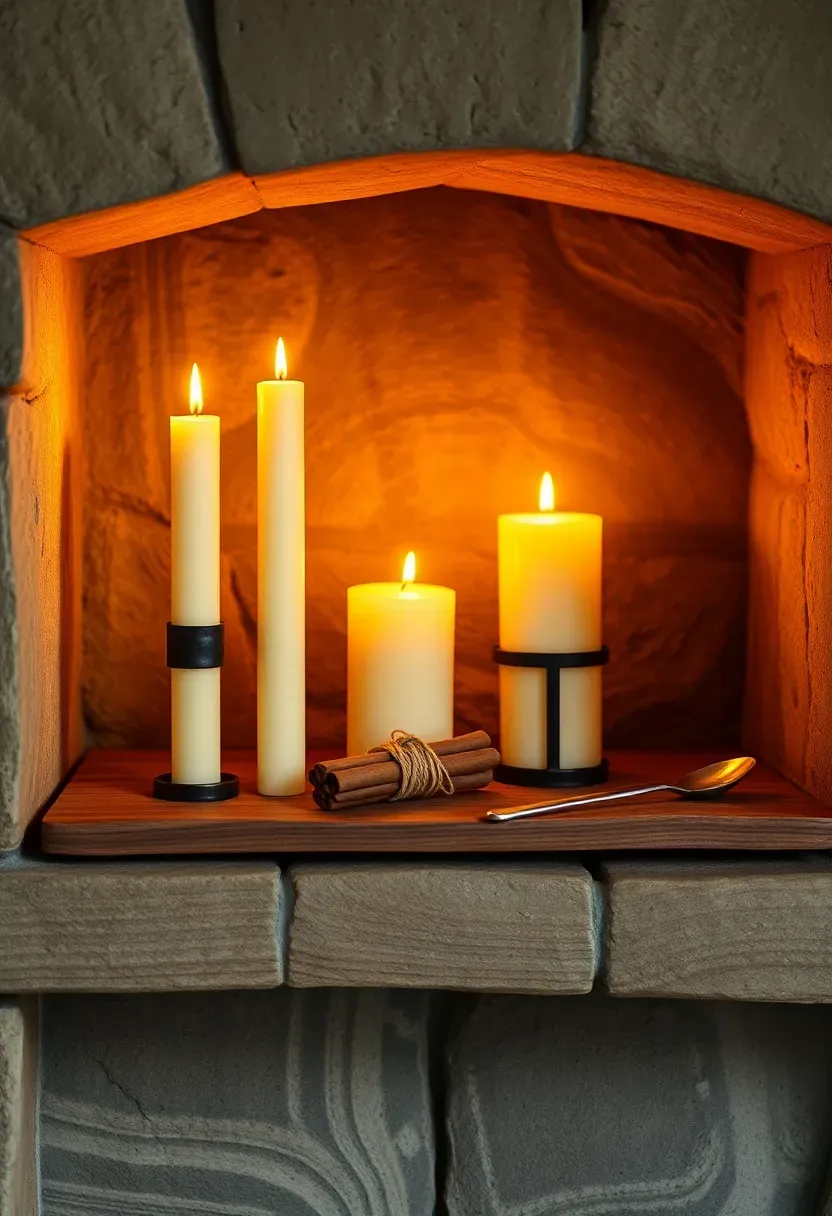
8. Candlelit Mantel Shelf
Before electric light, every mantel held candles. The mantel shelf was the illumination center of a room — functional, ceremonial, and beautiful all at once. Restoring that relationship between candles and shelf creates one of the most atmospheric antique displays possible.
A reclaimed wood shelf in a fireplace alcove is the ideal location, but any wall-mounted shelf gains presence from candlelight. Three ivory pillar candles in descending heights, a wrought iron taper holder at one end, and a silver snuffer at the other completes the practical side. Tuck a bundle of cinnamon sticks bound with raffia between the largest candle and the iron holder — the fragrance activates the display at a sensory level that purely visual arrangements never reach.
Living With This Display
Actually burn the candles. A shelf of candles that have never been lit looks like a props department. Dripped wax down candle sides, and a blackened wick, transforms a display into a lived experience. Replace candles as they burn down rather than letting them diminish to nothing — stop at roughly one-third of the original height for the most photogenic stage.
Recommended
Items for this idea
9. Cottage Pressed Flower Wall
Why Pressed Flowers and Antique Shelves Belong Together
The Victorian passion for botanical collection was democratic in a way that most period hobbies were not. Pressed flower herbaria required no expensive equipment — only patience, paper, and a heavy book. Women, children, and amateur naturalists across every social class practiced it, producing tens of thousands of albums that now surface in antique shops and estate sales worldwide.
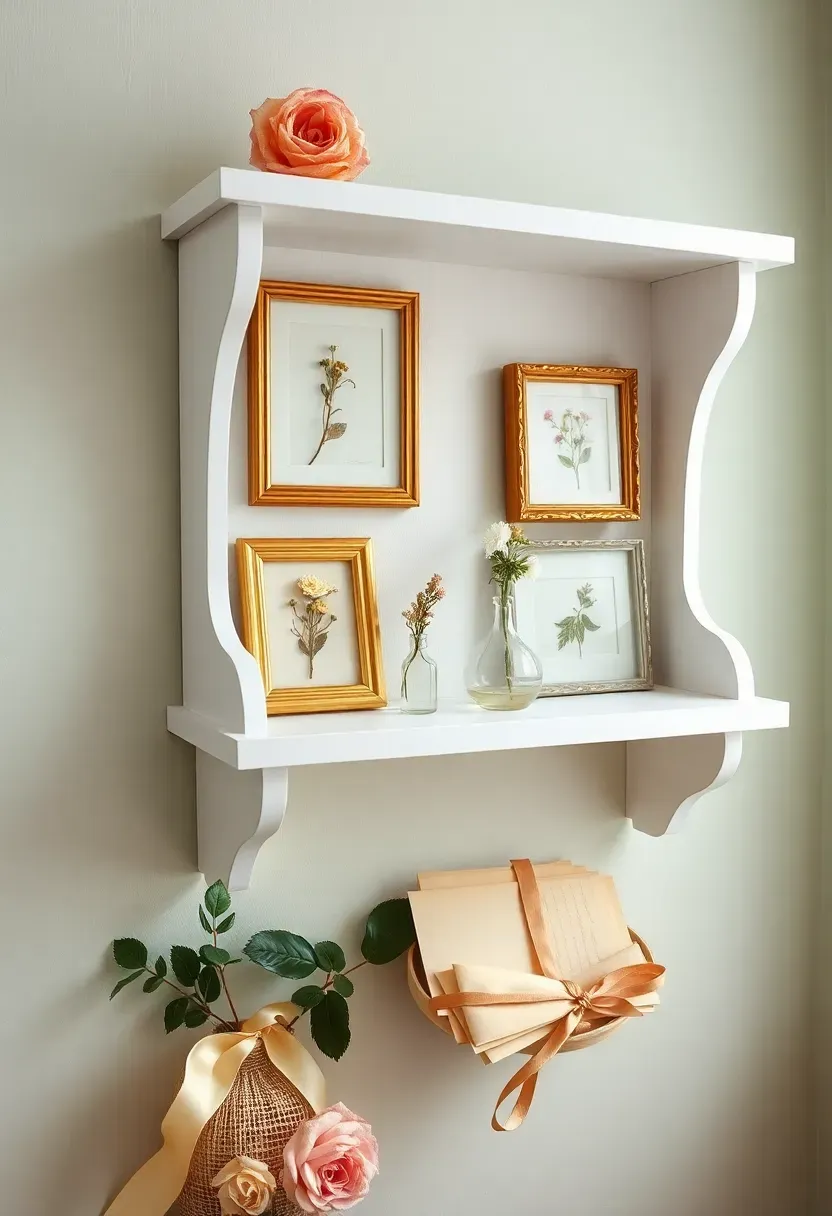
Building the Display
Four small gilded frames holding pressed specimens are the heart of the display. Lean them in a casual arrangement against the wall at the back of the shelf, overlapping slightly. Set a glass bud vase with a single dried rose head at the foreground. Place a bundle of old letters, tied with a narrow satin ribbon, horizontally across the shelf — their yellowed paper harmonizes with the aged botanical prints.
How to Apply at Home
- Make your own pressed specimens: heavy wildflowers and ferns press more successfully than succulent plants
- Gilded frames in varied sizes feel more collected than a matching set
- Natural linen or dried sage-green as the wall color amplifies the botanical palette
- Rotate specimens seasonally; pressing summer flowers in winter creates a quiet counter-seasonal pleasure
10. Industrial Vintage Blend
Comparing: Pure Antique vs. Industrial Vintage Hybrid
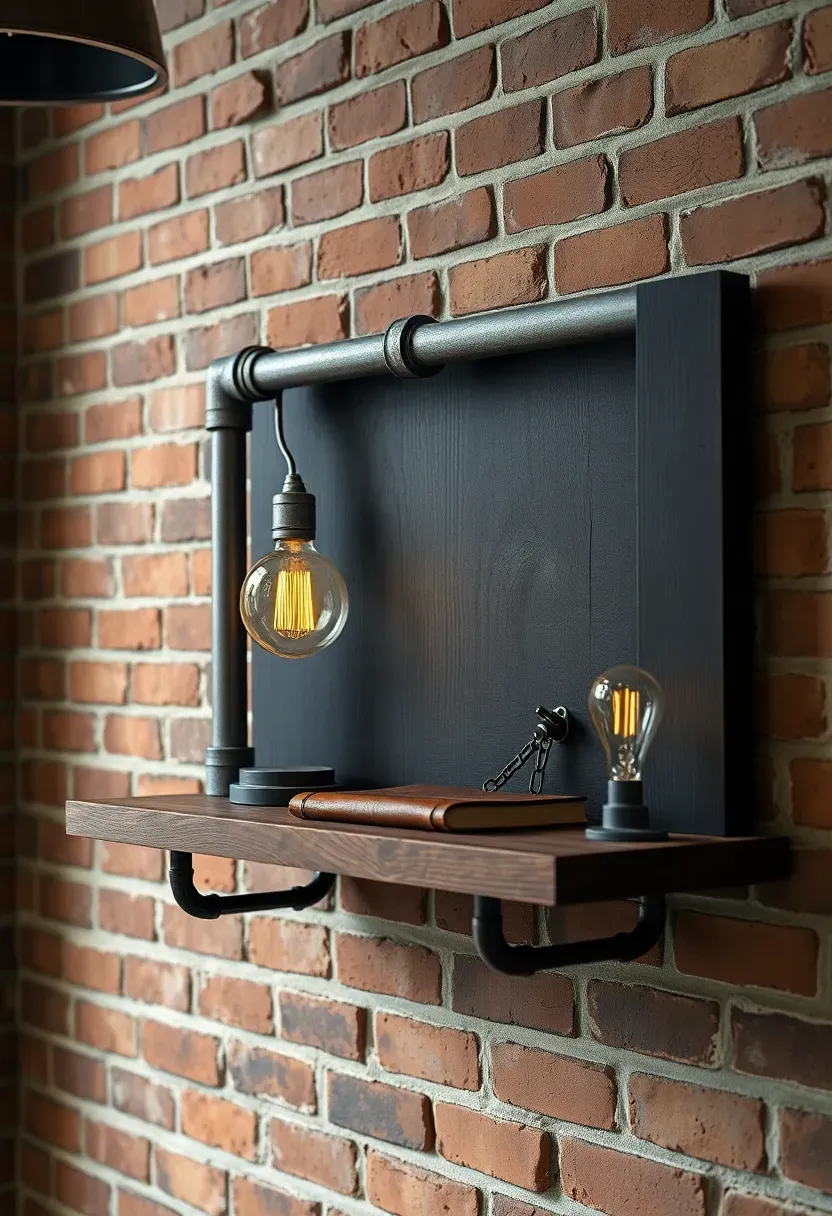
Not every vintage display needs to lean toward the delicate or domestic. The industrial aesthetic — raw steel, exposed brick, heavy iron — opens antique wall shelf displays to a different emotional register.
Pure Antique Approach
Objects chosen for fragility and rarity: porcelain, silver, pressed botanicals. Works beautifully in rooms with painted walls and period furniture. Requires careful lighting.
Industrial Vintage Hybrid
Raw steel pipe brackets supporting a reclaimed dark-stained oak plank. Objects chosen for patina and mechanical interest: a vintage Edison bulb lamp, a leather-bound journal, a cast iron bookend, a glass inkwell. Exposed brick wall as backdrop. The contrast between hand-crafted warmth (leather, wood, glass) and cold industrial materials creates a genuinely compelling tension.
What to Choose
Choose pure antique if: your interior has traditional finishes, plaster walls, period furniture, and warm-toned textiles.
Choose industrial vintage if: you're working with brick, concrete, dark-stained wood, or rooms with contemporary furniture that needs historical grounding.
Recommendation
The hybrid approach is particularly effective in converted spaces — old factory lofts, warehouse apartments, townhouses with exposed structure — where the industrial vocabulary is already present in the architecture.
Recommended
Items for this idea
11. Shabby Chic Pastel Arrangement
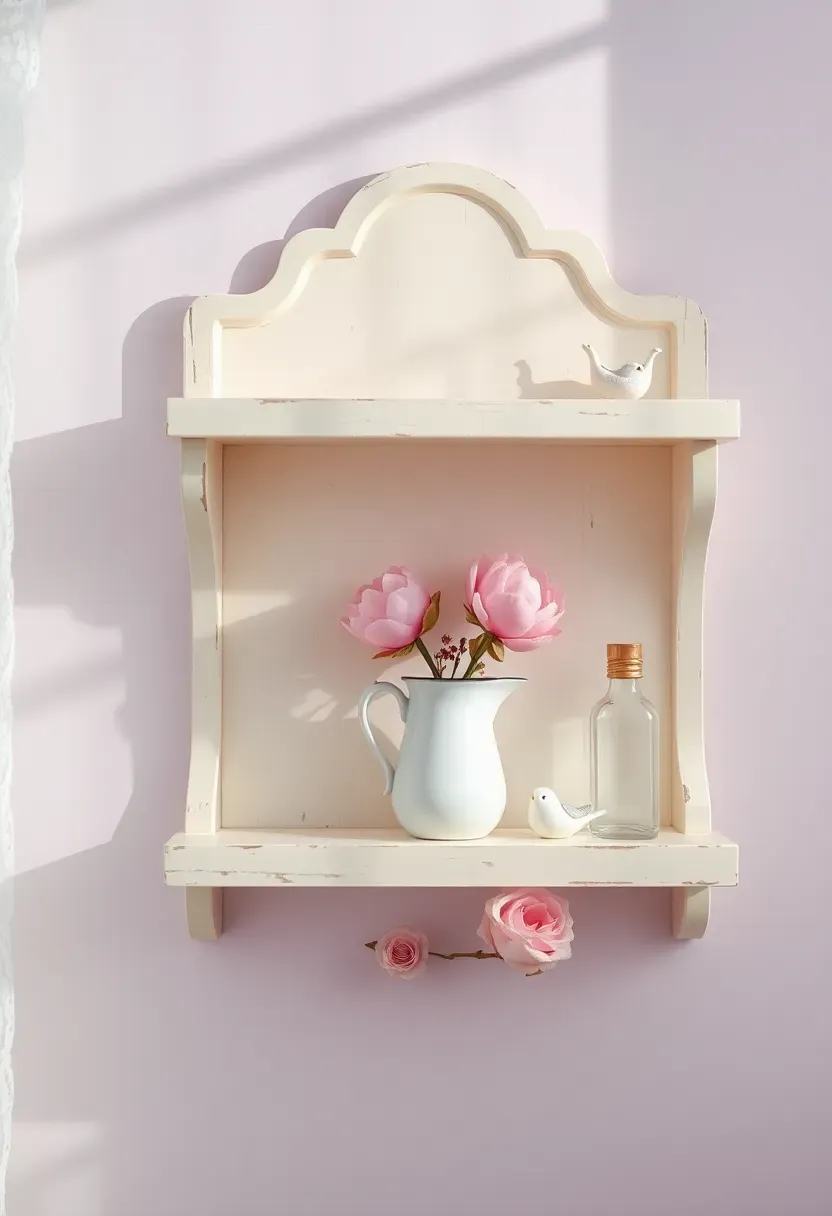
Imagine walking into a room that smells of dried roses and old wood, where every surface has gently faded to its softest version of itself. Shabby chic antique wall shelf displays achieve this atmosphere through deliberate imperfection — paint that has been allowed to chip, porcelain with fine crazing, enamel with honest wear.
A distressed cream shelf with scalloped bracket detail is the starting point. The character comes from the combination: dried peonies in a chipped white enamel pitcher introduce fragility alongside evidence of use. Small hand-painted ceramic birds (the kind found at provincial antique fairs) bring innocence. A vintage French perfume bottle in frosted glass completes the palette with something slightly elegant. Everything in the display has given itself up to time, and the shelf is all the more beautiful for it.
Key Technique
Distress your shelf selectively — sand corners and bracket edges where genuine wear would occur, not random patches across flat surfaces. Uniform distressing reads immediately as artificial; edge-specific distressing reads as real.
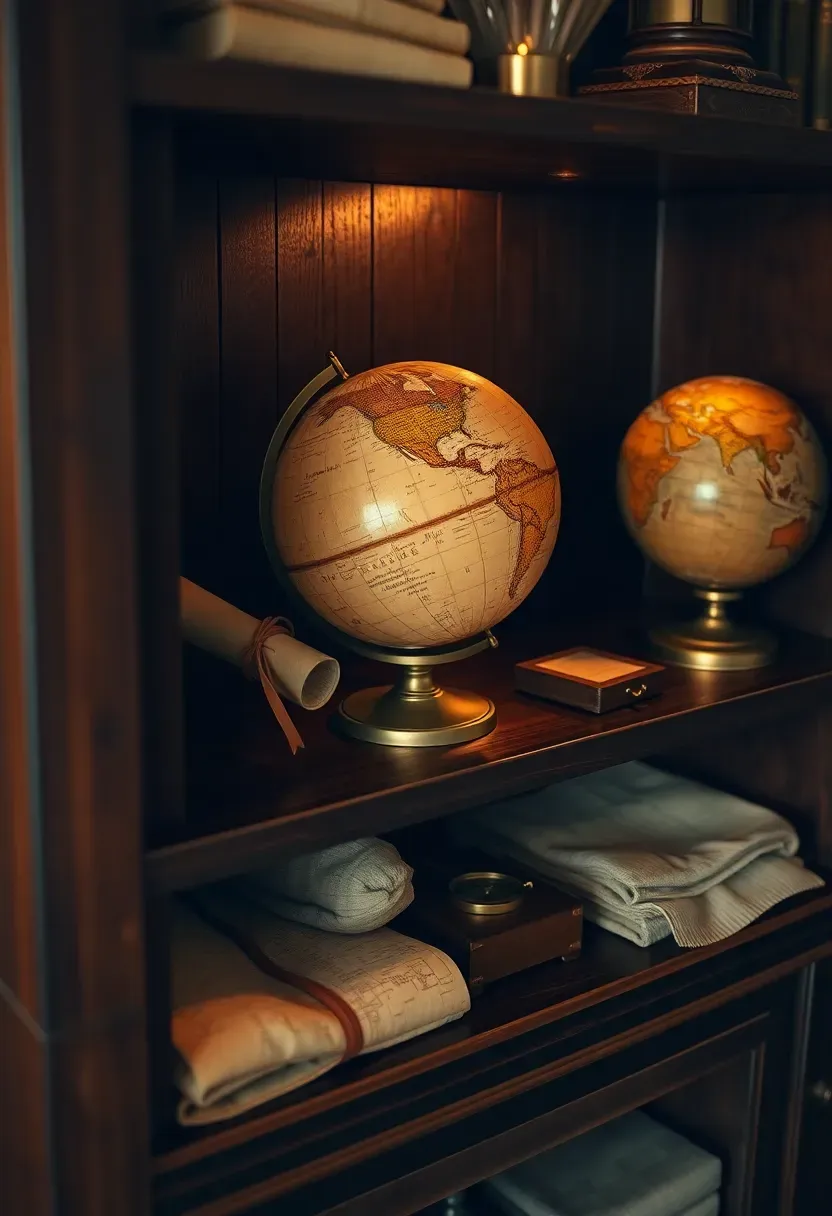
12. Antique Map and Globe Shelf
The Collector's Logic
Geography was once a gentleman's preoccupation. The ability to point to any location on a globe, to read a cartographer's projection, to hold a compass with authority — these were marks of education and worldliness. The objects of geographic exploration carry this seriousness even today, out of context on a wall shelf in a modern living room.
The Display
A wide dark mahogany shelf suits the weight of these objects. Position a small terrestrial globe on its brass stand at center-back — it earns the focal position. Roll an antique map and tie it with a leather cord; lean it diagonally against the globe. Place a brass compass in its open wooden case to the left. Fold a piece of linen surveyor's cloth — the kind that was once used for field maps — and let it drape slightly over the shelf edge. The drape introduces softness without losing the serious explorer's register.
Sourcing Note
Vintage educational globes from the mid-twentieth century are widely available and affordable. The older the cartography, the more interesting the display — borders that no longer exist are inherently poetic on a display shelf.
Recommended
Items for this idea
13. Vintage Travel Memorabilia
Step 1: Choose a Theme Within the Theme
Generic travel memorabilia loses focus. Choose instead a specific era (1920s ocean liner travel, 1950s European rail, colonial-era expedition) or a specific region (Paris, the Orient Express, the Mediterranean). This specificity makes the display feel like a genuine personal archive rather than a themed prop collection.
Step 2: Gather Three to Five Objects
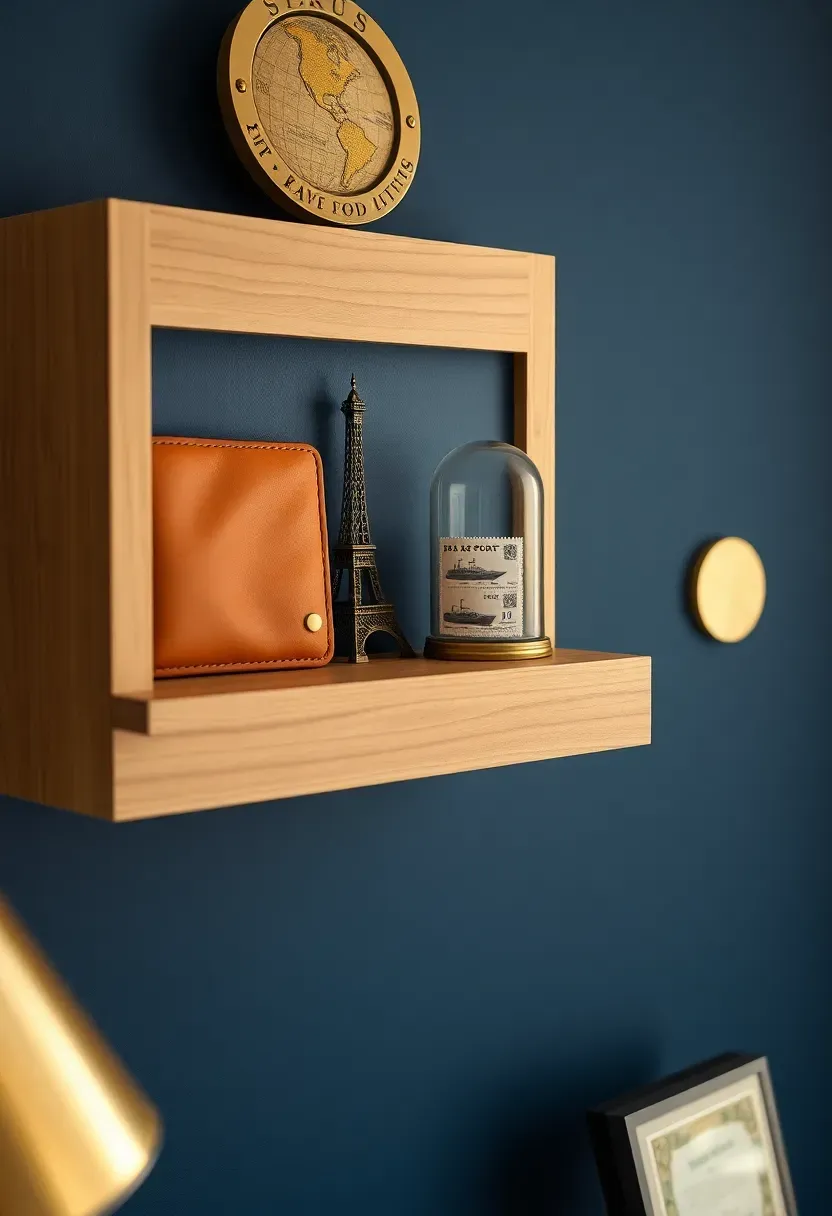
For a Paris-focused shelf: a worn leather passport wallet, a bronze miniature Eiffel Tower figurine with authentic casting detail, a set of vintage French postage stamps under a small glass dome, and a classic lithograph-printed tin. The objects suggest not one trip but a lifelong relationship with a place.
Step 3: Mount on a Contrasting Wall
A navy blue wall behind honey-oak floating shelves creates a striking contrast that gives the travel objects room to read. Dark walls absorb light and push objects forward visually — essential when the objects are small and detailed.
What to Watch Out For
- Mass-produced tourist replicas are immediately identifiable; look for older figurines with casting irregularities that confirm handwork
- Glass domes elevate small flat objects (stamps, pressed botanicals, coins) to specimen status — one dome per shelf is the right proportion
14. Weathered Driftwood Shelf
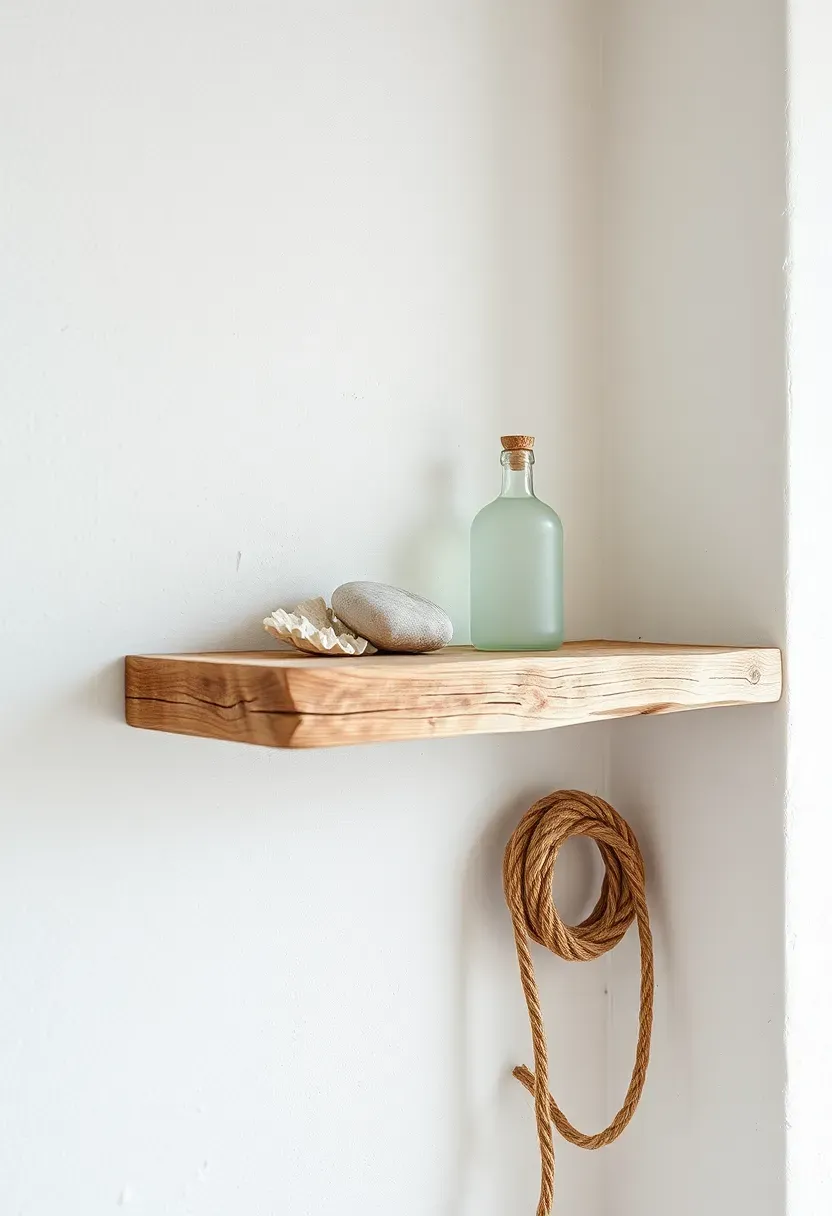
There's no antique wall shelf display that requires less human intervention than a driftwood shelf. The ocean does the distressing work — bleaching, smoothing, stripping — leaving behind material that carries genuine geological time rather than simulated age.
Mount an organic driftwood plank directly on a lime-washed wall using simple concealed brackets. The irregular shape is the display's first statement. Objects should share the same origin logic: bleached coral, a smooth round sea stone, a translucent frosted sea glass bottle with a shell stopper, a coil of natural jute rope. Nothing that came from a factory. Everything that came from the shore.
The Aesthetic Principle
This display succeeds through material consistency rather than object variety. Every item shares the coastal environment as its source. The result is a display that reads as a single unified thought rather than a collection of separately chosen pieces — which is the highest thing any antique wall shelf arrangement can achieve.
Recommended
Items for this idea
15. Art Nouveau Object Display
Origins
Art Nouveau (1890–1910) declared war on the geometric and mechanical. It drew from nature obsessively — sinuous plant forms, peacock feathers, dragonfly wings, woman as flower — and applied that vocabulary to everything from architecture to belt buckles. Objects from this period are among the most visually distinctive of any design era.
Modern Interpretation
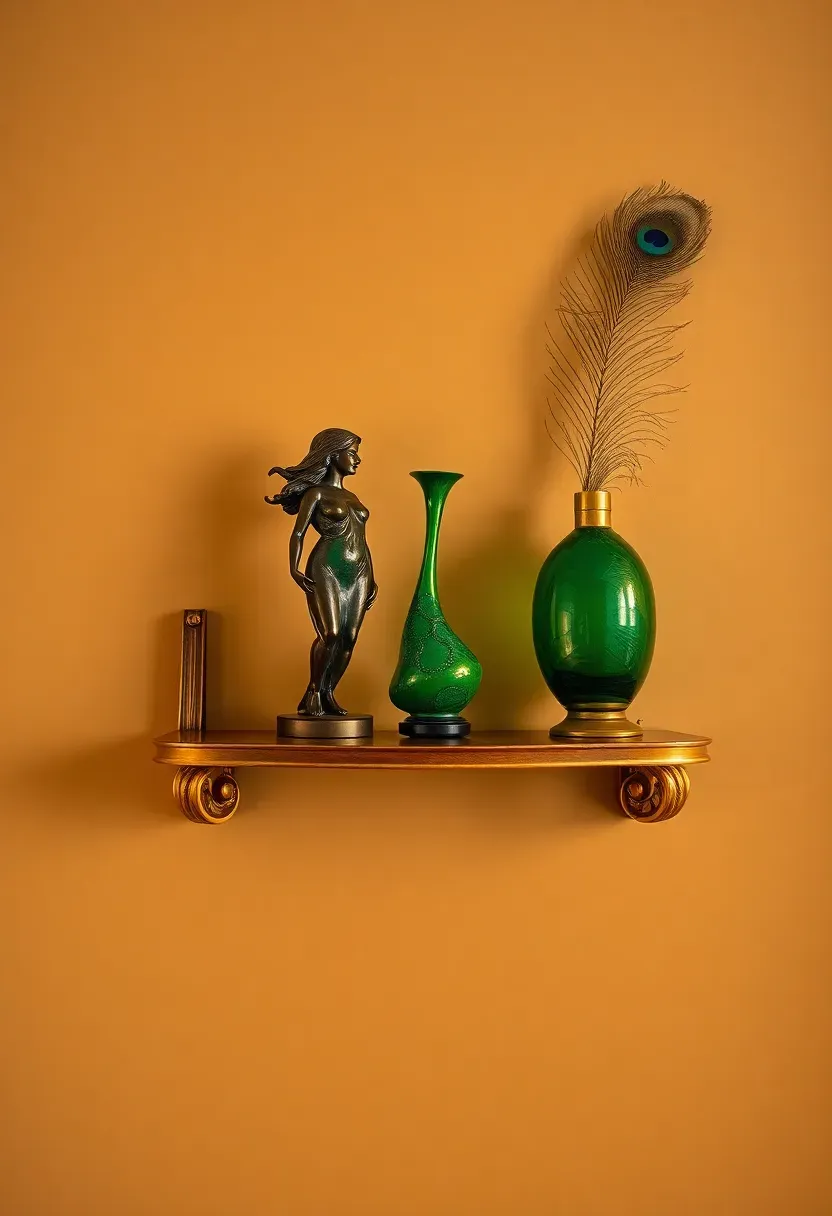
A shelf with organic carved bracket detail in warm wood sets the right stage. Three objects suffice: a sinuous bronze figurine with flowing lines, an iridescent Tiffany-style bud vase in jewel-green blown glass, and a peacock feather standing in a narrow brass vase. The iridescent glass is the key element — its color-shifting surface in light directly expresses the Art Nouveau fascination with natural light play.
How to Apply at Home
- Genuine Art Nouveau bronzes are expensive but appear regularly at estate sales; quality reproductions cast from period originals are a legitimate alternative
- The iridescent glass effect can be found in contemporary art glass studios at lower cost than antique equivalents
- Deep jewel-green or peacock blue wall color amplifies the display palette dramatically
- One strong object carries more impact than six middling ones — let the bronze figurine or the iridescent vase do the work
16. Scandinavian Folk Art Shelf
Why It Works
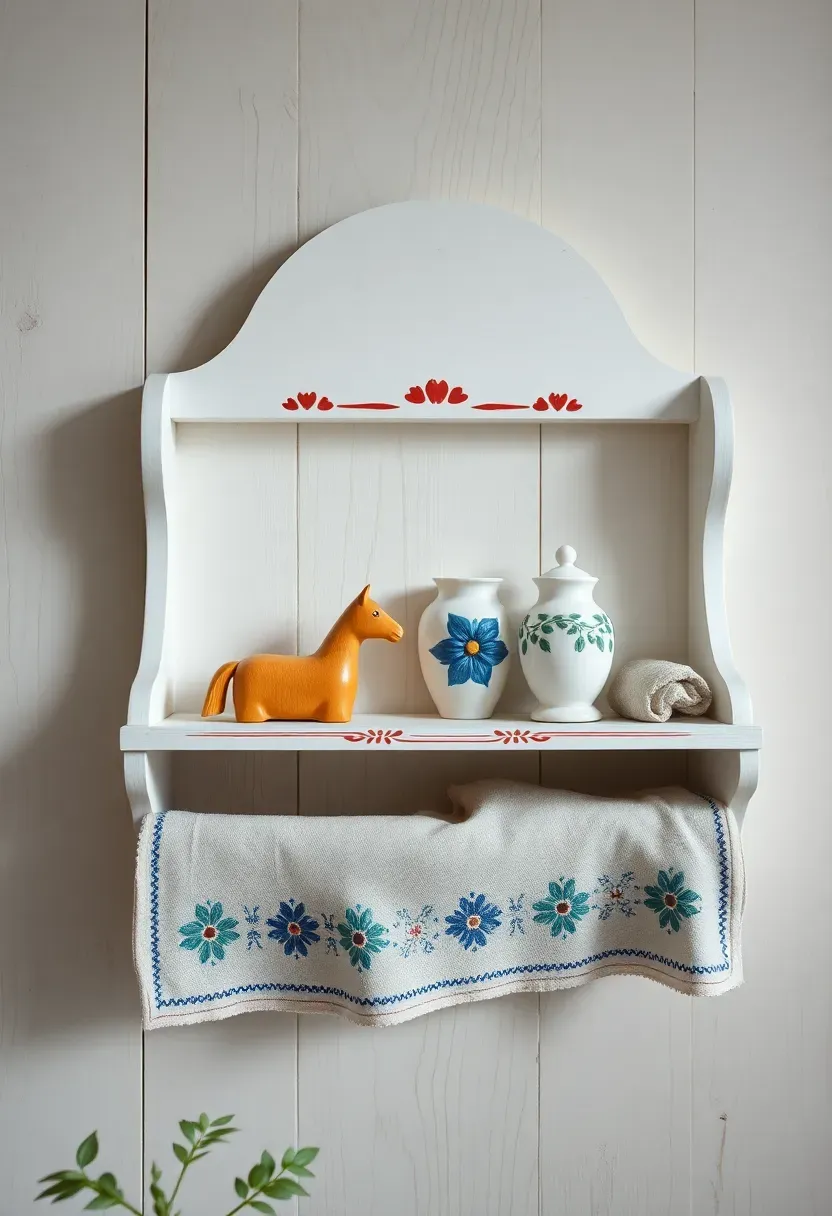
Scandinavian folk art achieved something remarkable: it made domesticity beautiful through skill rather than expense. Painted furniture, carved wooden figures, embroidered textiles — these were household objects elevated by the hands that made them. A Scandinavian folk art shelf display brings this tradition into contemporary homes without requiring Scandinavian heritage.
The Core Objects
A painted pine shelf with hand-applied rosemaling border detail is the stage. Two Dala horses — the iconic carved Swedish folk horse in traditional red or blue — anchor the display. A small white ceramic jar with a cobalt blue flower motif sits between them. A folded hand-embroidered linen cloth draped over the shelf edge introduces the textile dimension of folk craft.
The Color Logic
Folk palettes are bold and confident: primary red, cobalt blue, natural wood tones, white. Don't dilute them with contemporary neutral adjustments. The brightness is the point — it expresses the joy that folk artists invested in even the most utilitarian objects.
Recommended
Items for this idea
17. Antique Silver Collection
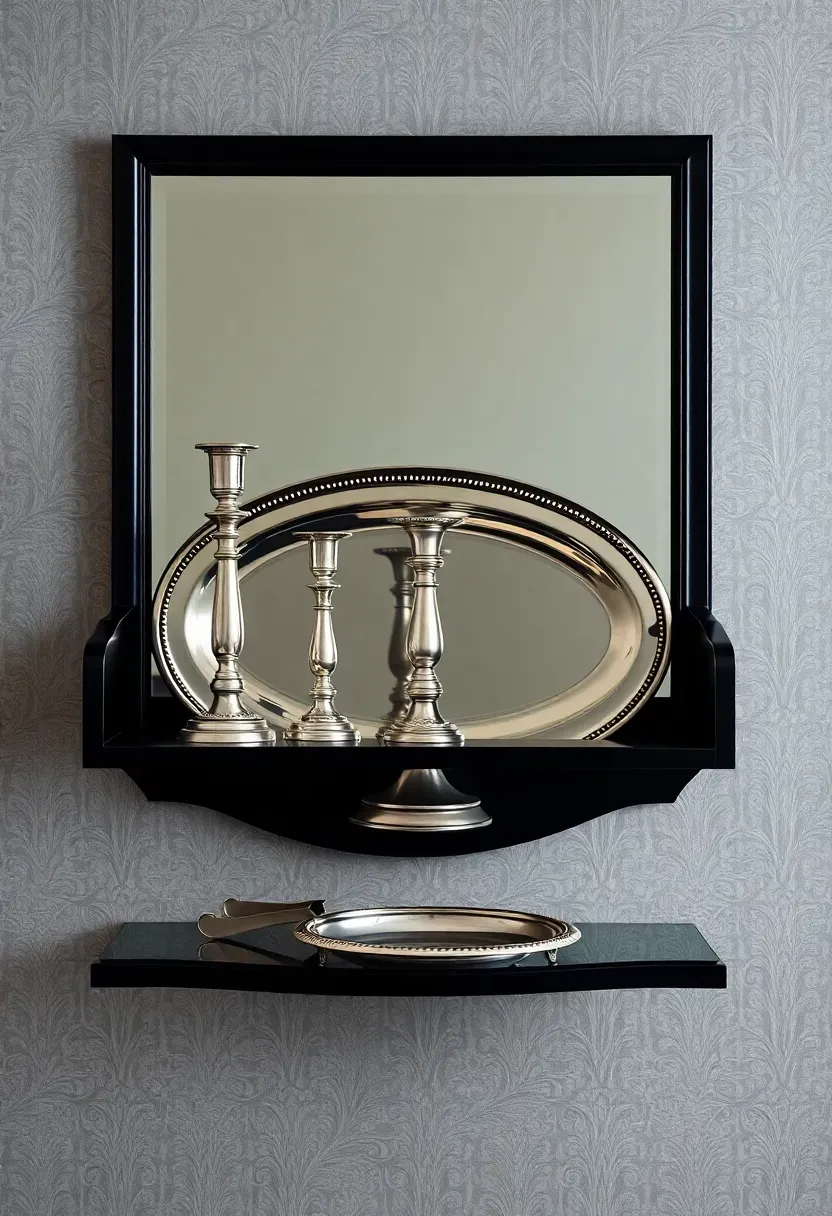
Silver is among the most forgiving of antique collecting categories — even heavily tarnished pieces respond to cleaning, and the selectively tarnished look (polished highlights with dark tarnish in engraved recesses) is arguably more beautiful than uniformly bright silver.
A shelf with an antique mirror backing amplifies silver dramatically: every candlestick and sugar bowl doubles in visual presence, and the reflections create spatial depth on an otherwise flat wall surface. Three polished silver candlesticks in descending height, a silver-plated oval serving tray propped upright as a backdrop panel, and a small sugar bowl with tongs complete the arrangement. The tray-as-backdrop is the structural key — it fills vertical space without requiring additional objects.
Maintenance Reality
Silver polishes quickly in air. Plan for a monthly light polish if you want the display to maintain its reflective quality. Alternatively, embrace the progressive tarnish as part of the display's evolution — a fully tarnished silver shelf has its own dark, atmospheric dignity.
18. Rustic Medicinal Herb Shelf
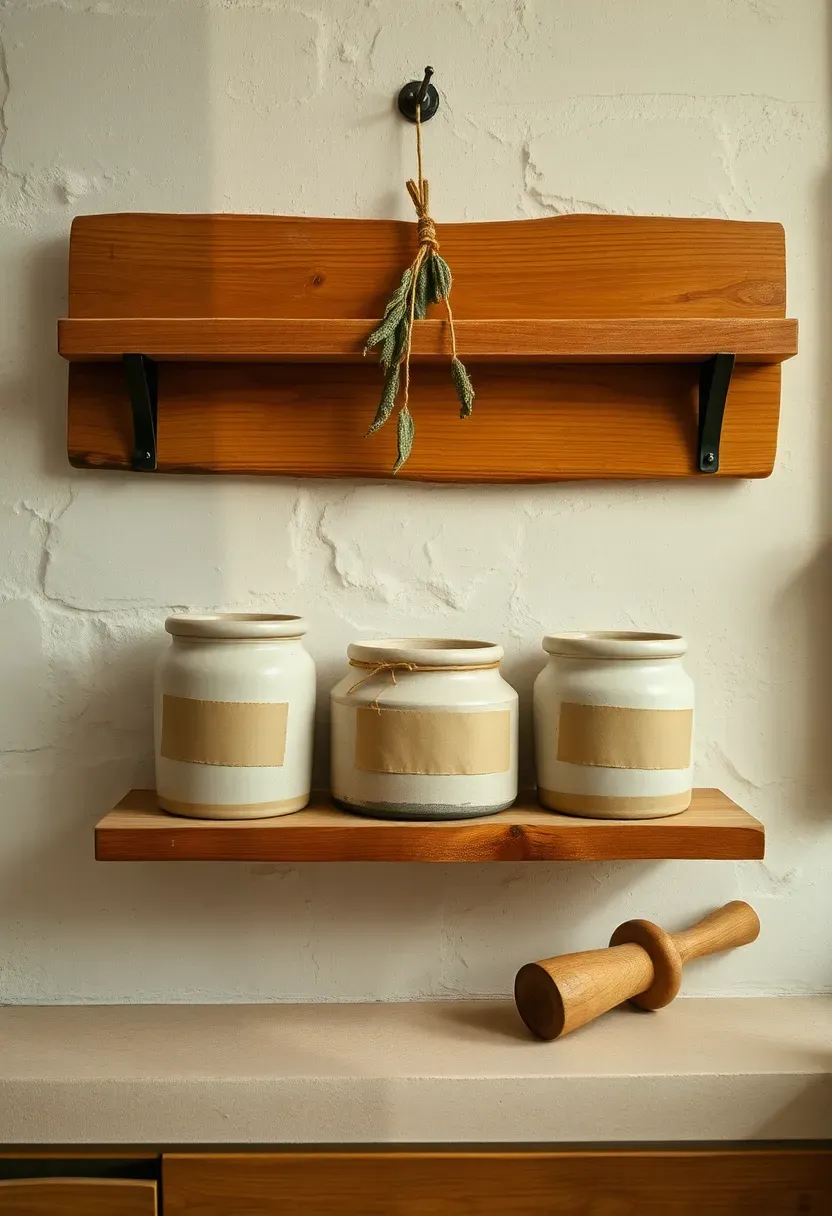
According to traditional domestic practice across Europe, the medicinal shelf was often the most carefully maintained surface in a farmhouse kitchen. The remedies stored there — dried herbs, bottled tinctures, sealed crocks — were household medicine. Recreating this display honors a tradition of care and self-sufficiency that feels newly relevant.
A rough-hewn pine plank on a whitewashed stone or plaster wall is the correct material note. Four hand-thrown stoneware crocks, sealed with parchment squares tied with hemp twine, line the shelf. A bunch of dried sage hangs from a small nail hook above the shelf, crossing slightly into the shelf's vertical space. A worn wooden pestle leans against the rightmost crock. No decorative objects. No artificial aging. The character comes entirely from genuine materials and genuine wear.
Sourcing Strategy
Look for studio stoneware potters who work with salt glazes and irregular forms. Handmade crocks look dramatically different from commercial imitations — the weight, the surface texture, and the slight variance between each piece create exactly the unevenness that makes this display convincing.
Recommended
Items for this idea
19. Vintage Music Corner
Step 1: Select the Era
Music antiques span three centuries of mechanical invention. Choose a specific technological era: 1920s acoustic gramophones, 1950s vinyl and hi-fi, 1800s piano sheet music and music boxes. A mixed-era music shelf looks confused; a shelf committed to one sonic period tells a coherent story.
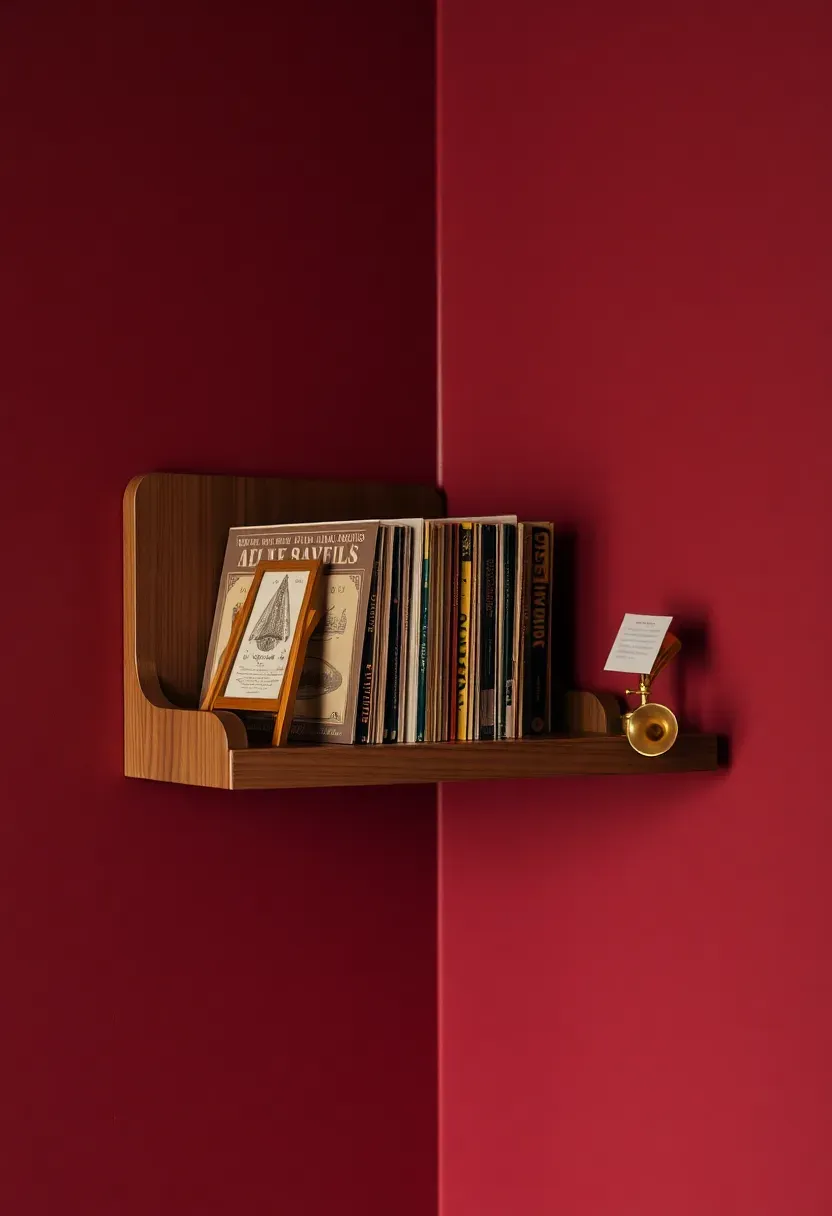
Step 2: Arrange the Objects
For a vinyl-era display on a warm burgundy wall: stand a row of four vintage record sleeves upright along the back of the shelf, leaning against the wall — their lithographed cover art functions as a gallery in miniature. Place a brass pyramid-base metronome at one end, ticking or stationary. Set a miniature vintage gramophone horn figurine in brass at the other end.
Step 3: Consider the Wall Color
Music displays benefit from warmer wall colors — burgundy, deep teal, dark ochre — that amplify the warmth of wood and brass without competing with the visual complexity of record sleeve artwork. Light walls flatten these displays; dark walls deepen them.
What to Watch Out For
- Record sleeve art is extremely variable in quality; be selective — two or three strong covers beat six mediocre ones
- The metronome should be positioned where someone might actually use it, not placed as pure ornament
20. Grandmillennial Book Stack
The grandmillennial aesthetic — which embraces chinoiserie, floral patterns, needlepoint, and the considered domesticity of an older generation — offers some of the richest material for antique wall shelf displays. Its central move is mixing periods unselfconsciously, the way actual inherited homes always look.
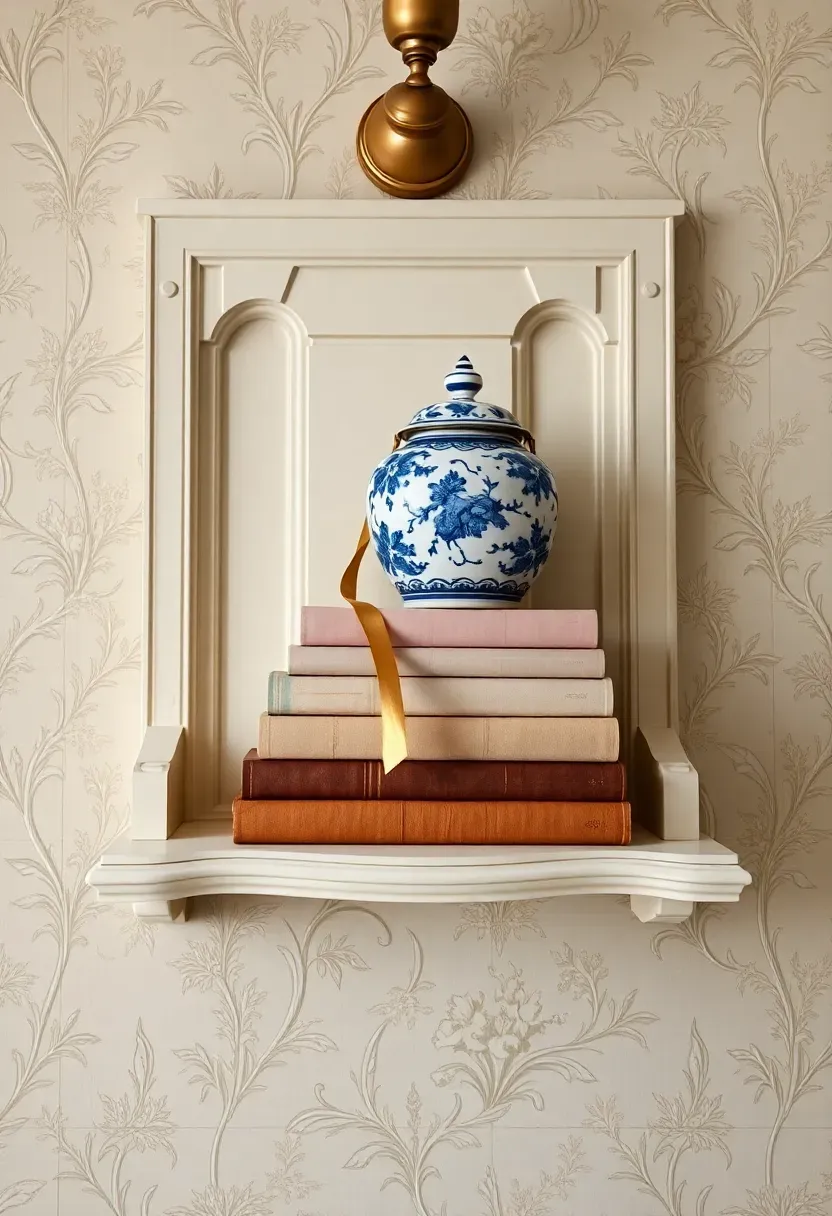
A painted ivory shelf with decorative bracket molding, mounted on a soft toile-patterned wallpapered wall, establishes the backdrop. Stack four cloth-bound books horizontally in complementary muted tones — dusty rose, sage green, ivory, soft grey. Place a chinoiserie ginger jar in cobalt blue and white on top of the stack: the contrast between a horizontal book arrangement and a vertical jar creates exactly the proportional interest grandmillennial styling thrives on. A small brass ribbon bookmark draped over the top book adds scale and warmth.
The Rule of Intentional Busyness
Grandmillennial styling can absorb pattern-on-pattern — toile wallpaper behind a patterned chinoiserie jar — because each individual element is beautiful and the palette stays harmonious. The rule: vary pattern scale. Large toile repeat behind small chinoiserie motif. If both patterns operate at the same visual scale, they compete rather than layer.
Recommended
Items for this idea
21. Colonial-Era Portrait Shelf
The Core Issue
Portrait miniatures are among the most overlooked categories of antique collecting. In the seventeenth and eighteenth centuries, they served the function that photographs would later fulfill — a portable, intimate record of a face. Displayed on a shelf, a portrait miniature in a gilded oval locket-style frame creates an emotional charge that reproductions and photographs never replicate.
The Solution
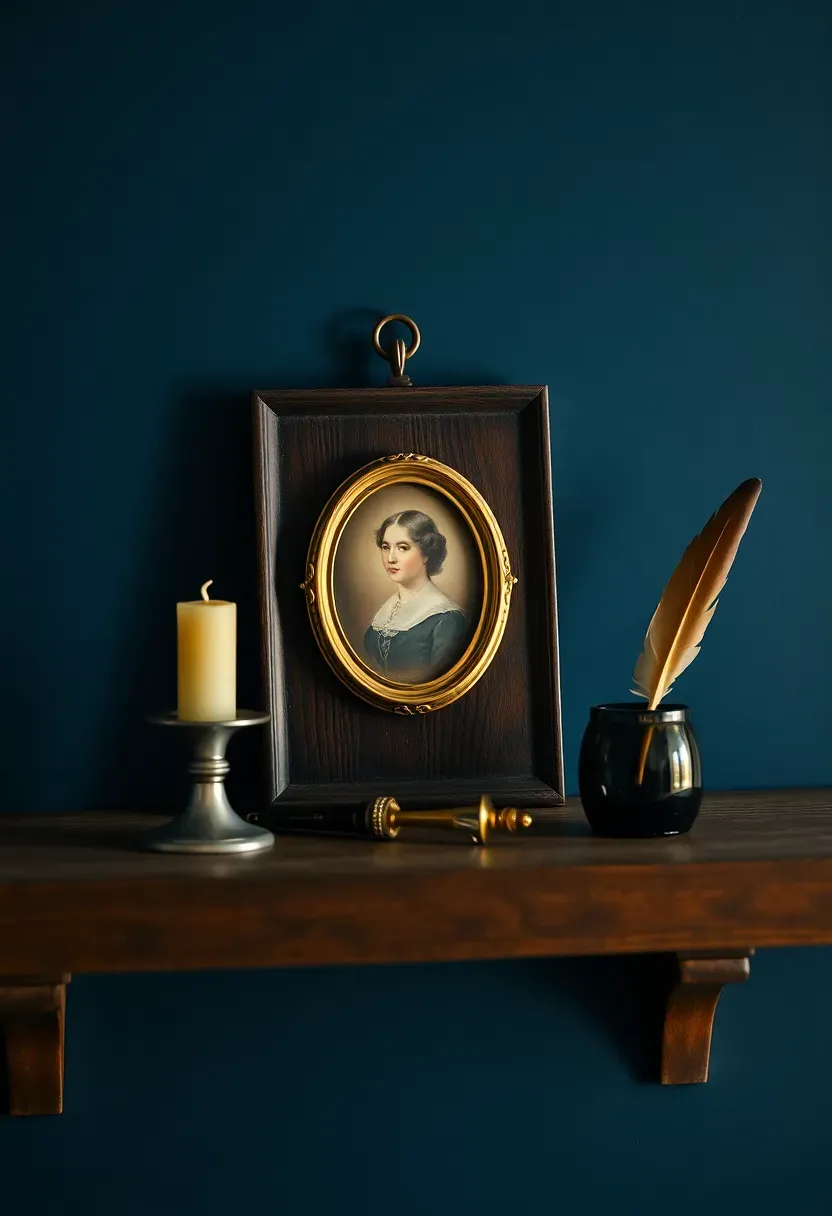
Mount a dark cherry wood shelf against a deep Colonial blue wall — the color grounding is essential, since colonial interiors used bold pigment to signal status. Center the gilded oval portrait miniature against the wall. Flank it with a tallow candle stub in a pewter holder (not a fresh candle — a used one) and a quill pen in a dark glass inkwell. These are objects of work and correspondence: the shelf implies a person who wrote letters and thought seriously.
Pros and Cons
Pros: Genuine portrait miniatures are findable at auction starting at modest prices; the display achieves remarkable emotional depth with only three objects; dark wall color makes the display read from across the room
Cons: A portrait miniature depicting an unknown person requires comfort with mystery — some people find this unsettling rather than atmospheric; the pewter candleholder tarnishes steadily and needs periodic attention
22. Antique Lace and Textile Display
Antique handmade lace occupies an unusual position in material culture — it is simultaneously fragile and durable, made from the simplest materials (thread, a needle or bobbin) yet requiring hundreds of hours to produce a few inches. Displaying lace on a shelf rather than in a drawer or box honors the labor invested in it.
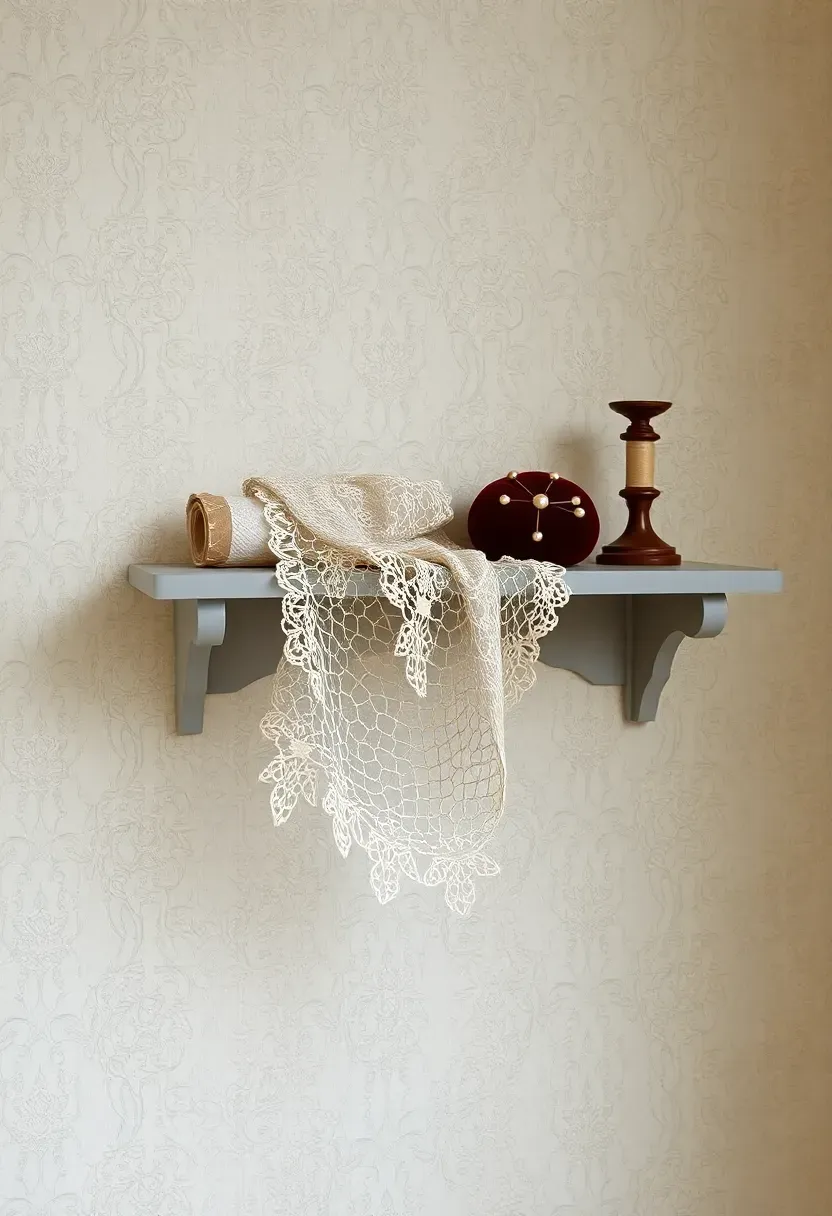
A slim pale grey shelf on cream embossed wallpaper provides a clean, quiet background. Drape a length of Venetian bobbin lace naturally over the shelf edge — don't arrange it too carefully; the casual drape looks lived-in where a perfect fold looks museum-like. A small burgundy velvet pincushion with three or four pearl-headed pins anchors the textiles-and-craft reading. An ivory bone tatting shuttle beside a small spool of silk thread completes the narrative: this is a maker's shelf, not a display case.
Preserving Antique Textiles on Display
- Direct sunlight yellows lace progressively and irreversibly; use only north-facing or interior walls
- Avoid displaying lace in humid rooms; bathrooms and kitchens accelerate fiber degradation
- Rotate displayed lace every few months, storing folded pieces in acid-free tissue paper
Recommended
Items for this idea
23. Forgotten Keys and Locksmith Vignette
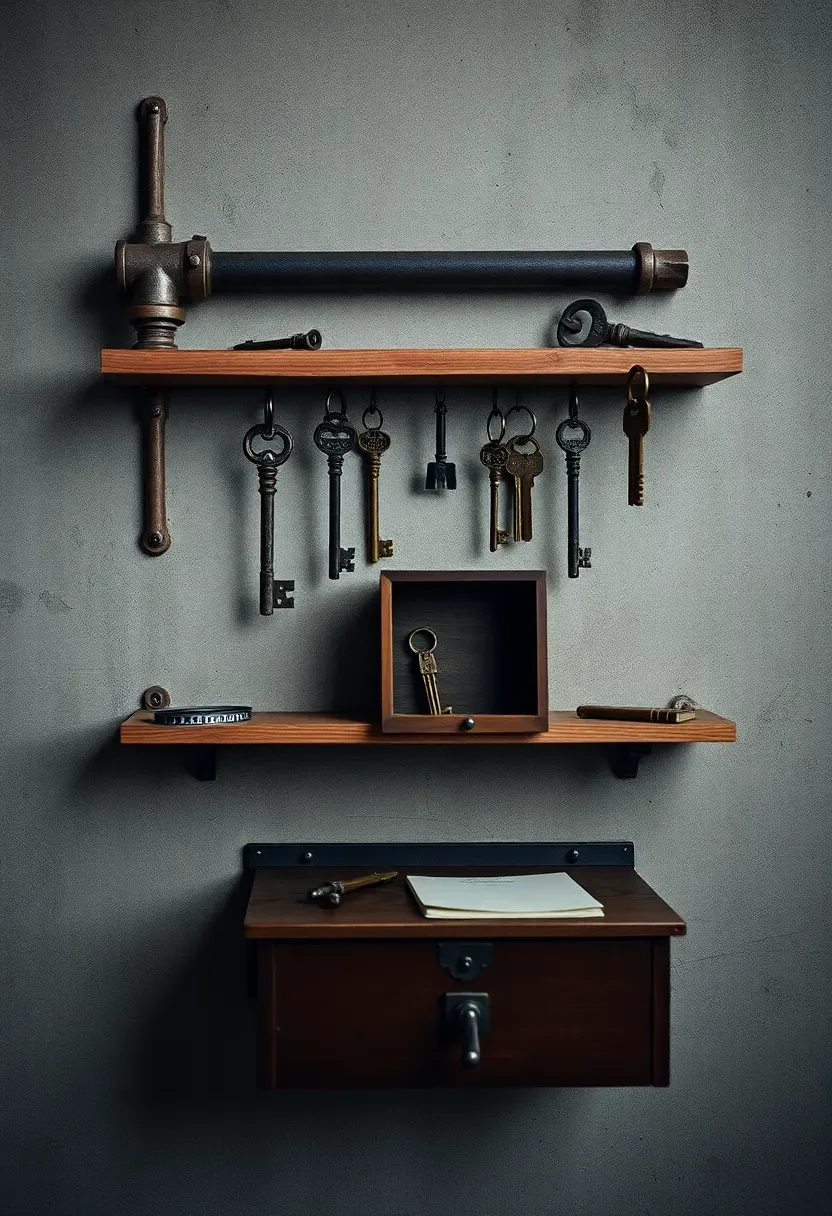
Why do antique keys fascinate so reliably? Partly their physical quality — the weight and specificity of hand-forged iron, the precision of cut brass. Partly the suggestion of locked rooms and forgotten secrets. A collection of seven skeleton keys, arranged by era and material on nail hooks above a weathered oak plank, creates one of the most unusual and compelling antique wall shelf displays available.
The raw concrete wall suits the iron keys better than plaster or wood paneling — the grey industrial surface amplifies the cold weight of old iron while warming it with the wooden plank. A small open-front key cabinet box on the shelf holds overflow keys as three-dimensional suggestion. A locksmith's flat file resting on the plank implies the keys are in a working collection, not sealed behind glass.
Curation by Material
Mix iron and brass keys deliberately: the contrast between dark forged iron and bright worked brass produces visual rhythm. Iron keys tend toward earlier periods (medieval, early modern); brass keys cluster in the Victorian era. Arranged roughly chronologically from left to right, the display becomes a small material history.
24. Eastern European Folk Ceramics
The Tradition
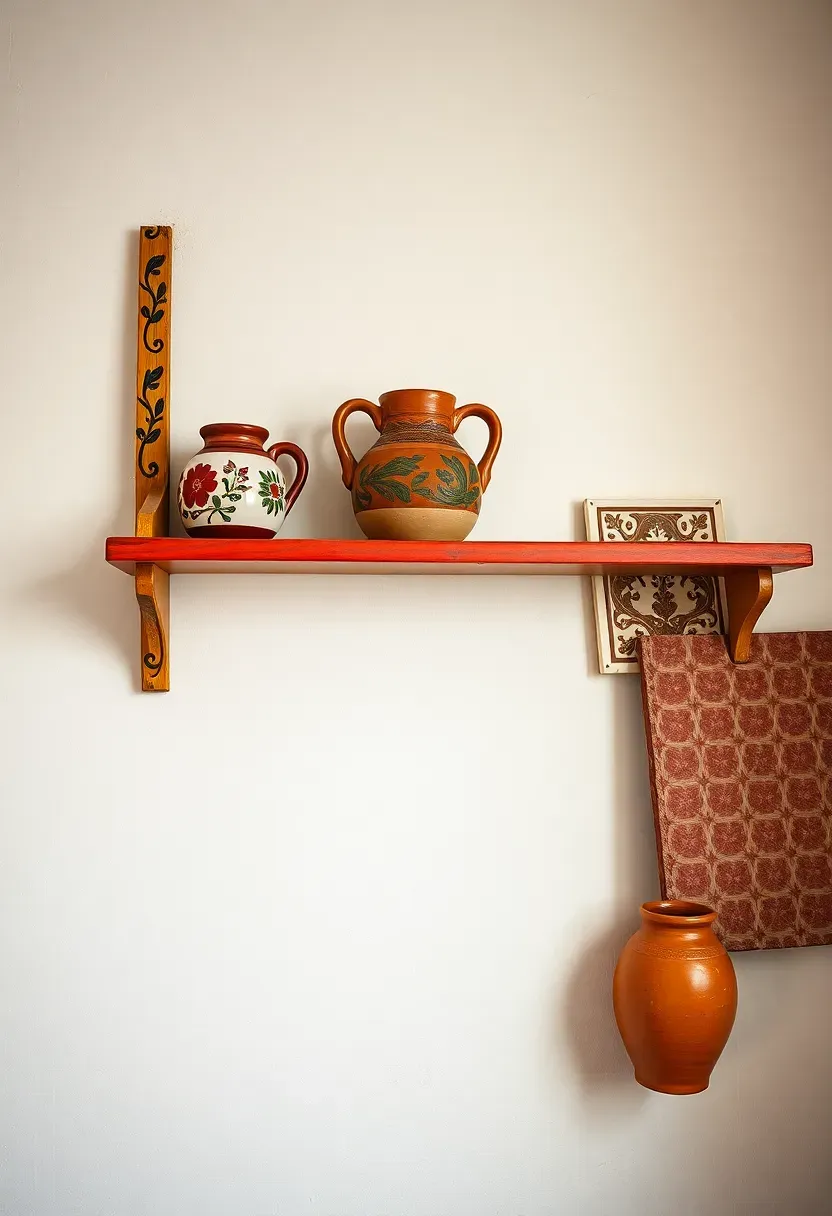
From Polish Boleslawiec pottery to Bulgarian troyan ceramics, Eastern European folk ceramic traditions share a commitment to bold decoration, functional form, and handmade irregularity that distinguishes them absolutely from industrial production. These ceramics were made to be used — for water, for wine, for pickled vegetables — and their beauty emerged from the constraints of utility.
The Display
A painted wooden shelf with a traditional rosemaling-adjacent folk border in red, black, and ochre brings the display's framework into the same decorative vocabulary as its objects. Three hand-thrown pottery jugs with slip-decorated folk patterns in earthy tones — terracotta, deep ochre, dark brown, cream — stand in a loose row. Two painted ceramic tiles, propped upright at the back of the shelf, introduce flat pattern as counterpoint to the dimensional jugs.
How to Apply at Home
- Polish stoneware and Czech folk pottery appear regularly in European import shops and online specialty retailers at accessible price points
- Irregularity of form is a quality indicator, not a flaw; hand-thrown pottery shows varied wall thickness and slightly asymmetric profiles
- White plaster walls provide the cleanest backdrop for the bold ochre-and-terracotta folk palette
- Grouping pieces of different heights adds energy; all the same height reads as a lineup
Recommended
Items for this idea
25. Sepia Photography Gallery
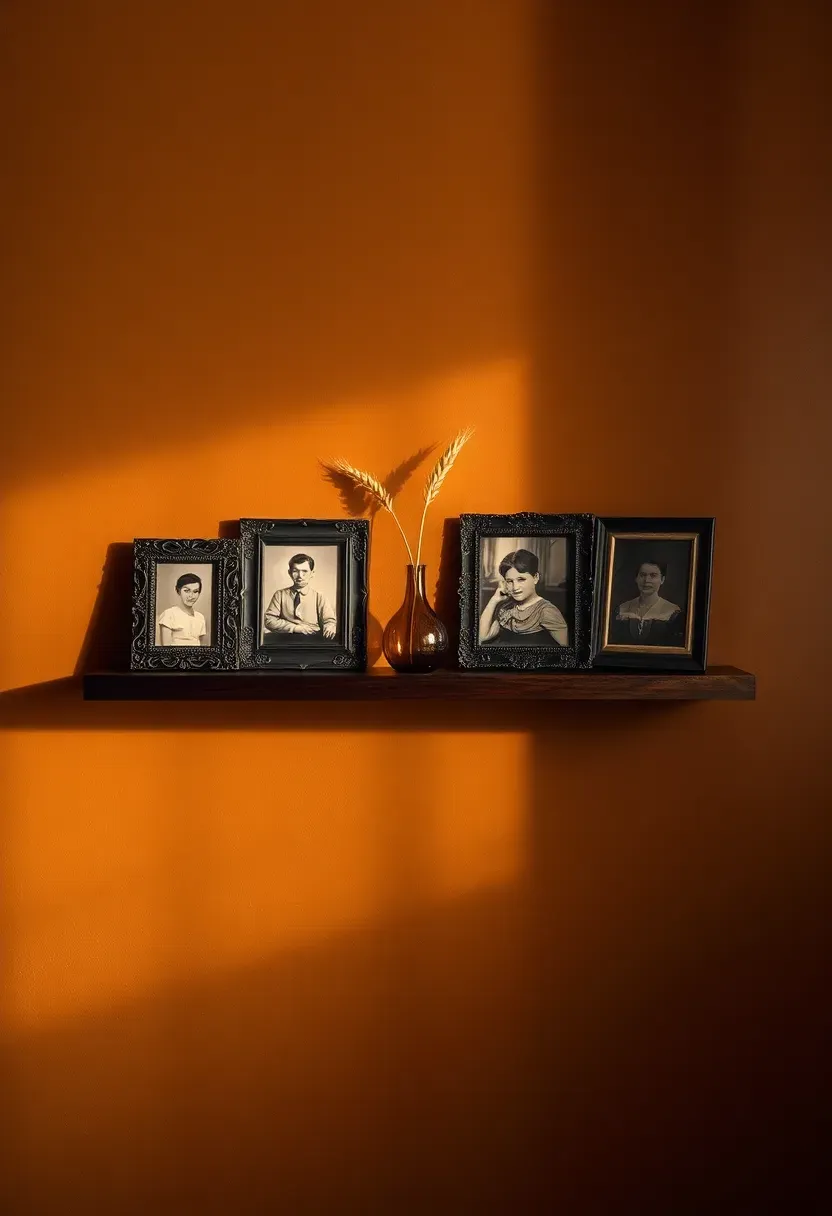
According to contemporary interior stylist observations, gallery-style arrangements of antique photographs represent one of the fastest-growing approaches in vintage home decor — driven by both the accessibility of estate-sale photographs and the emotional depth they bring to a wall.
An ebonized shelf against a warm tobacco-brown wall provides the richest possible background for sepia tones. Five small framed vintage portraits in ornate dark frames, arranged at varying heights, leaned rather than hung — some overlapping slightly — create the effect of a private family archive. Between two of the portrait groups, a single amber glass bud vase with a dried wheat stem occupies just enough space to prevent the photographs from crowding into a solid block.
On the Ethics of Displaying Strangers
Found photographs of unknown people are among the most intimate and slightly uncanny objects in antique collecting. Some collectors feel an obligation to these faces; others see them simply as historical objects. Either relationship is legitimate. The faces — whoever they were — are now part of your home's visual history, which has its own quiet poetry.
26. Vintage Science Instruments
Comparing: Natural History vs. Physical Science Collections
Scientific instrument collecting divides broadly into natural history (specimen-based: butterflies, fossils, pressed plants) and physical science (instrument-based: telescopes, barometers, compasses). Both work beautifully on wall shelves; each produces a different intellectual atmosphere.
Natural History Approach
Specimen boxes, herbarium books, and magnifying equipment. Warm, organic, closer to the botanical and collector traditions. Works well in rooms with warm wood tones and earth-palette walls.
Physical Science Approach
Precision brass instruments, chamois-wrapped implements, folded observation notebooks. More austere, architectural, suggesting exact measurement and systematic inquiry. Works particularly well with cool sage green or slate blue walls.
What to Choose
Choose natural history if: you want warmth and organic visual texture, and your room already includes botanical or ceramic elements.
Choose physical science if: you want intellectual precision and the clean aesthetic of brass and dark wood on cool-toned walls, in a study or home office.
Recommendation
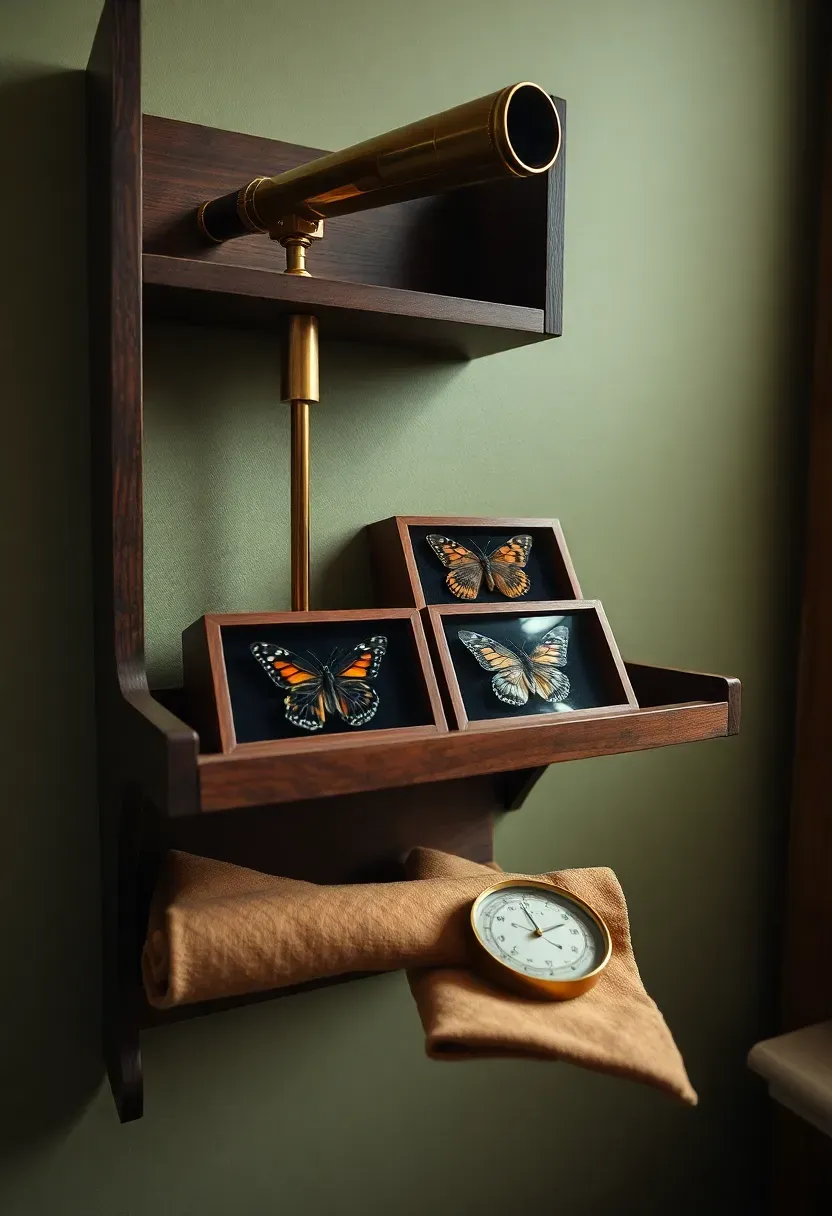
A dark walnut shelf in a sage-green study, holding a brass telescope on an adjustable stand, a butterfly specimen box with glass lid, and a brass pocket barometer on folded chamois cloth — this arrangement communicates the gentleman naturalist's study without a single period-specific prop that's difficult to source.
Recommended
Items for this idea
27. Eclectic Mixed-Era Curio Wall
The final and perhaps most personal approach to antique wall shelf displays: the genuine cabinet of curiosities, assembled over years from sources with nothing in common except that each object caught your eye and refused to leave your possession.
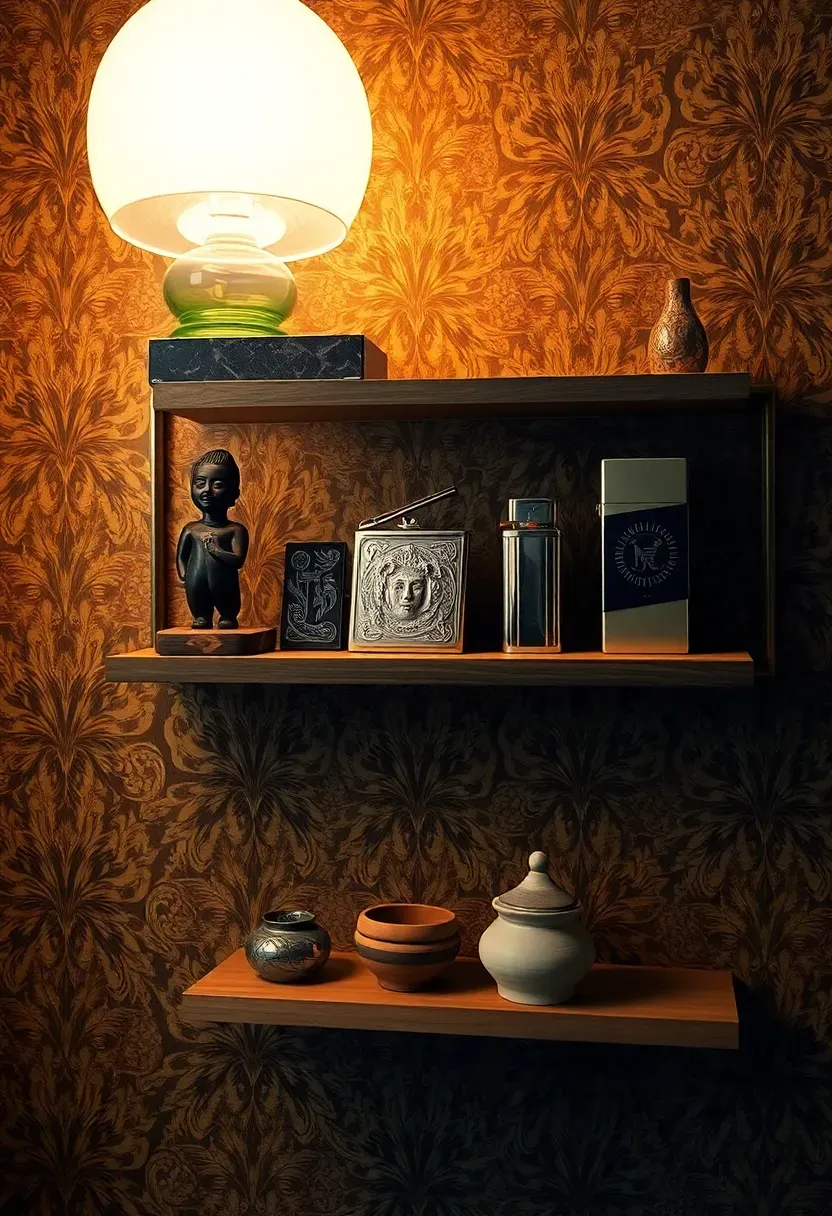
Two floating shelves of mismatched heights and materials on a richly patterned vintage wallpaper background — already visually complex before a single object arrives. Then the objects: a Murano glass vase in jewel tones, an African carved ebony figurine, a Victorian silver calling card case, an Art Deco chrome cigarette lighter, a rustic hand-thrown clay pinch pot. Different continents, different centuries, different makers, different purposes. The wallpaper pattern provides the visual cohesion that the objects cannot provide for themselves.
The Rule of Provenance Contrast
Each object in a mixed-era display should be obviously different in origin from its neighbors. When objects from different eras and regions are placed too close to their material cousins, the collection loses its expansive quality. One wooden thing next to another wooden thing reads as a wood collection. Ebony beside chrome beside clay beside glass reads as a life fully lived.
Quick FAQ
Is it worth investing in genuine antiques for shelf displays, or do reproductions work equally well?
Genuine antiques bring surface qualities — oxidized patina, legitimate wear, material weight — that quality reproductions approximate but never fully replicate. For objects that will be seen closely and frequently, such as a small shelf display, genuine antiques are worth the additional effort of sourcing. Reproductions work better in backgrounds and at distances where surface quality is less legible.
Should an antique wall shelf display be themed around a single era or style, or can eras be mixed?
Both approaches succeed when committed to. A single-era display (all Victorian, all French country) achieves coherence through shared material language. A deliberately mixed display succeeds through what collectors call "cabinet of curiosities" logic — each object earns its place individually, and variety is itself the organizing principle. The display that fails is the one that mixes eras accidentally, without an intentional logic.
How do you prevent antique shelf displays from looking dusty and neglected rather than atmospherically aged?
The distinction lies in selective dusting. Dust flat surfaces and the tops of objects — these are the surfaces that accumulate household dust indistinguishably from neglect. Leave textured surfaces, engraved recesses, and aged crevices alone; cleaning these removes the legitimate patina that makes aged objects valuable. A lightly dusted display of genuinely old objects looks maintained; a heavily cleaned one looks stripped.
What's the minimum number of objects needed to make an antique wall shelf display read as intentional?
Three objects at minimum, five at maximum for most shelf widths. Below three, the display reads as incomplete rather than spare. Above five, most shelves lose the breathing space that makes individual objects legible. The exception is a collection of one type (keys, clocks, portrait miniatures), where higher numbers reinforce the collection reading rather than undermining it.
Which wall colors best support antique shelf displays?
Deep, historically grounded tones — forest green, Colonial blue, burgundy, tobacco brown, warm terracotta — support antique objects better than pale neutrals, which drain warmth from aged materials. A dark wall pushes objects forward visually, making even small displays readable from across the room. If repainting is not possible, a painted panel behind the shelf in a deeper tone achieves the same effect at shelf scale.
Trends come and go, but the pull of objects that carry age and history doesn't operate on a trend cycle. A shelf holding three things that were made by hand a century ago will look as compelling in twenty years as it does today — more so, perhaps, because each passing year adds another layer to the story. Start with one shelf, two or three objects that genuinely interest you, and let the display find its own logic over time. The best antique wall shelf displays are never finished; they simply continue.
Pinterest cover for 27 Antique Wall Shelf Displays That Transform Your Walls Into Art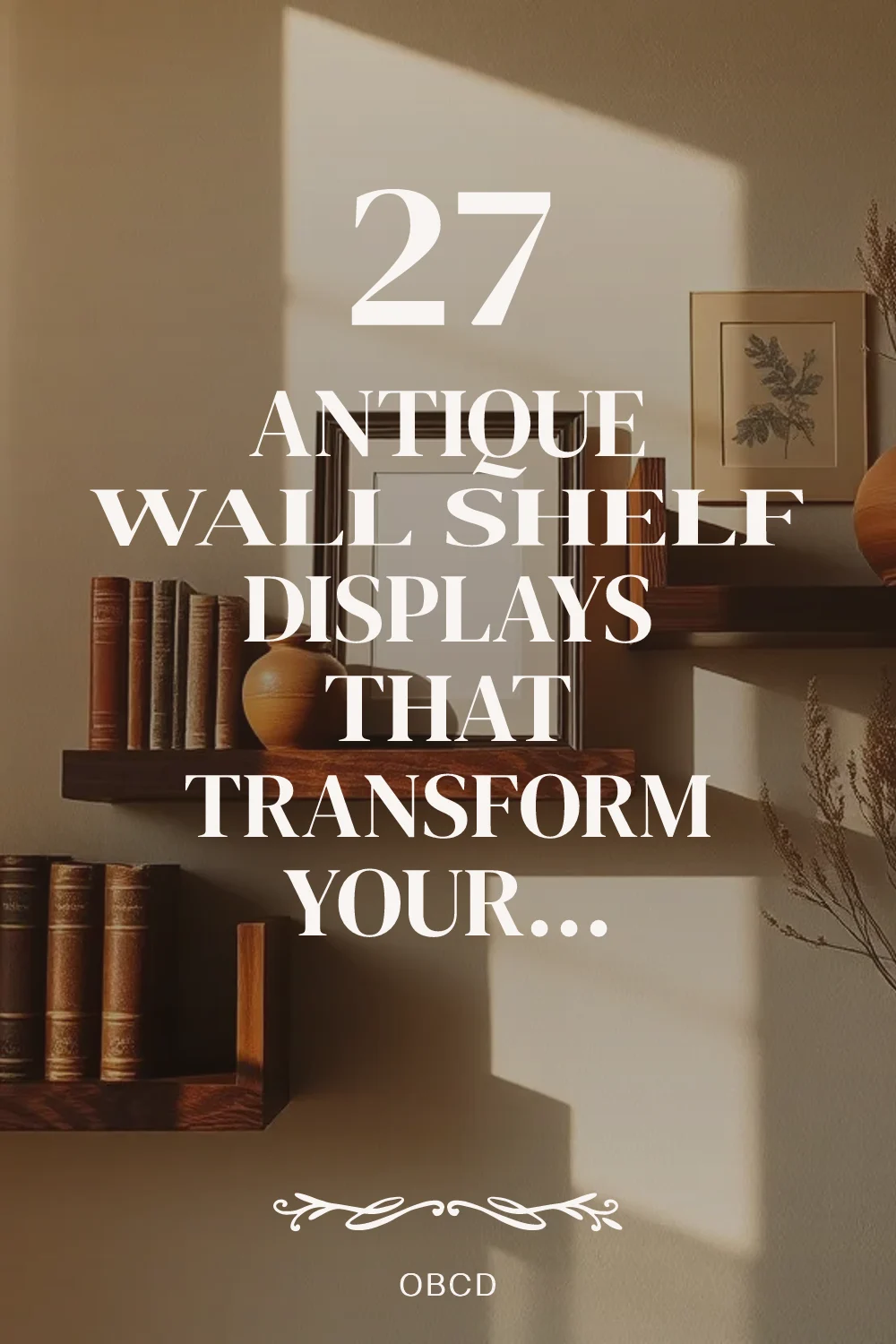
About the author
OBCD
CGI visualization and interior design content. We create detailed 3D renders and curate practical design ideas for every room in your home.